








Elif Özaksu
Corporate
- Thread Author
- #1
💡 Technology Overview
Complex computing needs in manufacturing facilities often force engineering teams to use separate development environments for compact sensors, industrial PCs, and central servers. To address this architectural fragmentation, evopro systems engineering AG, a subsidiary of Bertrandt AG, has integrated Bosch Rexroth's Linux-based operating system, ctrlX OS, into its image automation portfolio.
By deploying the VISIONWEBx application environment on ctrlX OS, evopro is creating a standardized runtime framework for the automotive data ecosystem and digital supply chain, where machine vision tasks can be scaled across multiple execution layers without code re-writing.
🎯 End Fragmentation in Vision Deployment
Machine vision applications in modern manufacturing and logistics have historically suffered from rigid architectural coupling. An inspection algorithm designed for a compact smart camera could often not run on an industrial PC (IPC) or edge server without significant software refactoring. This disparity increases the total engineering burden, complicates lifecycle maintenance, and hinders the real-time transfer of visual inspection metrics to higher-level operational systems.
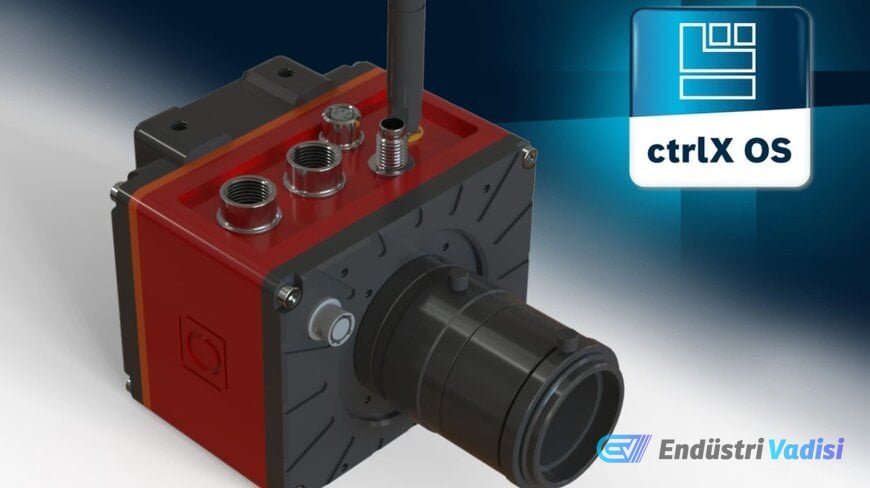
By adopting ctrlX OS as an OEM partner and launching the evoVIU VIUx software-defined camera, evopro is creating an architecture where image algorithms are decoupled from specific physical targets. The browser-based VISIONWEBx development and runtime environment, offered through the ctrlX OS Store, allows engineers to design, parameterize, and run image inspection workflows once, then scale the same execution logic from a smart camera on the device to a central server.
⚙️ Embedded Hardware and Processing Architecture
The evoVIU VIUx hardware platform operates directly at the machine layer to process image data at the point of capture, thereby minimizing network bandwidth overhead and latency for deterministic downstream control.
At the heart of the camera's computing architecture is an NXP i.MX95 applications processor paired with a Hailo-8 AI accelerator. This heterogeneous silicon structure offloads complex deep learning workloads, such as high-speed inference for anomaly detection, from the main host CPU. To meet diverse sensing requirements in factory environments, the camera platform supports modular sensor configurations, including:
- Short-Wave Infrared (SWIR) sensors: For non-destructive material analysis and inspection through opaque packaging.
- High-resolution global shutter image sensors: For distortion-free capture of components moving at high line speeds.
- Time-of-Flight (ToF) sensors: For precise 3D spatial coordinate generation and volumetric analysis.
For control integration, the device includes real-time industrial fieldbus support via EtherCAT, which allows image inspection data to directly trigger axes and motion logic without being routed to external gateways. Independent network interfaces ensure operational separation between Operational Technology (OT) determinism and Information Technology (IT) telemetry.
🏭 Industrial Applications
The combination of edge AI acceleration and native automation connectivity targets various manufacturing domains:
- In-line quality assurance: Automated optical inspection, surface defect scanning, and optical character recognition (OCR) or Data Matrix code reading on continuous assembly lines.
- Industrial robotics: 3D point cloud acquisition and localized coordinate transmission for robotic guidance, bin picking, and automated pick-and-place routines.
- Intralogistics: Volumetric tracking, automated product sorting, and material flow monitoring across conveyor networks.
💻 Software-Defined Vision Strategy
Positioning machine vision software as encapsulated applications within a standardized Linux distribution reflects an ongoing shift towards software-defined manufacturing. In this model, physical vision devices serve as flexible execution endpoints within a broader software infrastructure.
According to Steffen Winkler, Senior Vice President of the Automation and Electrification Solutions Business Unit at Bosch Rexroth, the integration provides an end-to-end foundation for industrial image processing, from smart cameras, edge controllers, industrial PCs, and virtualized server environments, allowing users to develop an application once and deploy it to their desired hardware layer.
Stefan Kraus, Head of Product Development and Product Manager for evoVIU at evopro systems engineering AG, states that physical AI requires image processing, AI, and automation to work as a coherent system. The open architecture enables visual sensing routines to be directly matched with actionable control functions in real-time processes.




















