




Elif Özaksu
Corporate
- Thread Author
- #1
🚀 Revolutionary Integration from Universal Robots and Inbolt
Universal Robots and Inbolt made a significant announcement at SPS 2026, revealing the direct integration of Inbolt Standard, their AI-powered 3D vision guidance software, into Universal Robots' 7th generation robot platform. This innovation eliminates the need for external industrial PCs, enabling collaborative industrial robots to locate components from CAD files and dynamically adjust taught paths in every cycle. It offers significant advantages, particularly in automotive, electronics, and data center hardware manufacturing.
💡 Embedded Architecture and Hardware Connection
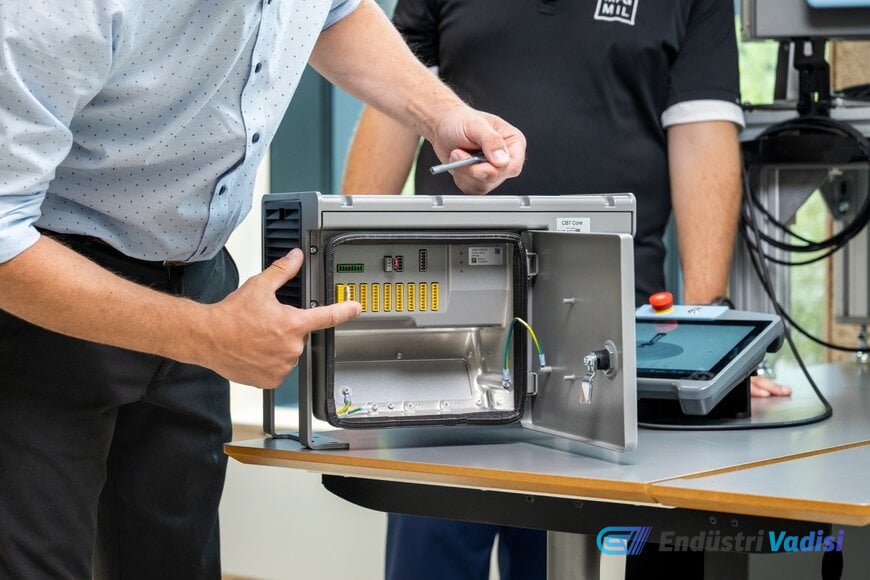
Following the September launch of Universal Robots' 7th generation platform, Inbolt became one of the first UR+ partners to run its AI application directly on the CB7 Core controller. Inbolt Standard's native operation on the robot's main processor eliminates the external industrial PC previously required for 3D vision guidance. This reduces hardware footprint and simplifies installation, deployment, and system support.
Hardware integration is supported by the 7th generation tool flange, which includes dedicated power connectors and a 1 Gb Ethernet port. An Orbbec 3D camera connects directly to the tool flange, transmitting power and data signals through the robot arm rather than external cables. Anders Billesø Beck, Vice President of AI Robotics Products at Universal Robots, stated, "The 7th generation is our physical AI platform, providing our partners with the computing, connectivity, and tools to develop AI applications and deploy them directly to the robot. Inbolt Standard is a clear example of what this brings to the factory floor in terms of usability and reduced integration time."
⚙️ Software-Defined Part Positioning and Industrial Use Cases
A 3D camera mounted on the robot wrist recognizes and positions components according to CAD files in each cycle, replacing custom mechanical jigs and fixtures with software-defined path adjustments. Product changes transform from physical tooling projects into software updates. A single program can switch between more than 80 part references, and plant engineering teams can retrain the system locally when adding new components.
Inbolt Standard targets primary use cases such as screwing, bolt tightening, de-racking, machine tending, and layered pallet unloading in automotive assembly. In high-mix electronics and data center hardware manufacturing, it supports tray and rack loading, fastening, and torquing operations.
📊 Performance and Compatibility
System configuration and part training are performed by Inbolt Studio, which runs as a URCap on PolyScope X, while real-time part positioning is executed on the CB7 Core processor. Training is done locally on the controller in less than 10 minutes using the component's CAD file. This eliminates the need for image datasets, manual labeling, or external cloud data transfer.
For stationary parts, the system achieves 0.5 to 0.7 mm repeatability. The Orbbec camera uses active infrared depth sensing to ensure consistent positioning in bright, dim, or dark factory lighting conditions. Inbolt Standard runs natively on Universal Robots g-Series models (UR10g-1750, UR17g-1300, and UR18g-950) with PolyScope X 10.13 or higher. The software is also compatible with e-Series and UR Series robots equipped with the CB7 controller, though these configurations require an external cable to connect the camera.
🔍 Technical Comparison
In the 3D robot vision market, third-party guidance platforms like Pickit 3D, Mech-Mind, and Photoneo typically require an external industrial PC (IPC) to process point cloud data and transmit coordinates to the robot. While these architectures offer scalable GPU computing for complex random bin picking operations, they add cabinet space, external cabling, and multi-vendor deployment costs. In contrast, Inbolt Standard's native operation on the CB7 Core controller aligns with the footprint of OEM integrated vision systems like FANUC iRVision, running directly on the robot controller without an external PC.
Inbolt's reported 0.5 to 0.7 mm repeatability and 0.5-second cycle processing time are well-suited for applications such as semi-structured assembly, fastening, and machine tending. Furthermore, the sub-10-minute CAD-based local training distinguishes its workflow from deep learning vision systems that require hundreds of labeled sample images and cloud-based GPU training.