






Hasan S. Cemkan
Corporate
- Thread Author
- #1
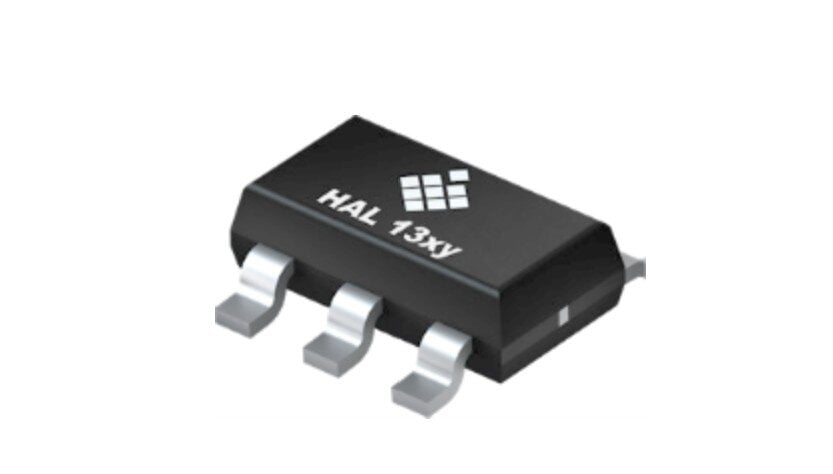
In the modern industrial and automotive sectors, compact electric motors and actuators are becoming increasingly important. However, this miniaturization presents engineers with new challenges in obtaining precise speed and position data. This is precisely where the TDK Micronas HAL 13xy family comes in!
─────────────────────────
💡 No More Spatial Constraints: 3D Hall Technology
Unlike traditional sensors, the HAL 13xy series offers a 3D Hall-effect sensor architecture that can simultaneously measure two orthogonal magnetic field components. This provides much greater flexibility in the placement of the sensor and magnet. Mechanical tolerances, air gap variations, or magnet distance inconsistencies encountered in applications such as window lifters, electric seats, or tailgate openers are no longer an issue.
─────────────────────────
📊 Precise Control with Dual Output: Quadrature Signal Processing
Thanks to their dual output capability, these sensors can provide either quadrature signals for speed tracking or separate speed and direction signals. Their most remarkable feature is their ability to maintain a stable 90-degree phase shift despite fluctuations in the magnetic air gap or magnetic pole pitch. This phase stability reduces the need for calibration, simplifying encoder and motor controller designs. It offers an ideal solution for critical applications such as steering wheel turn count detection, sunroof motor regulation, and anti-pinch window lifters.
─────────────────────────
🛡️ Functional Safety and Electrical Robustness
Uninterrupted operation in harsh electromechanical environments requires robust fault tolerance mechanisms. The HAL 13xy family operates reliably across a wide temperature range from -40°C to +150°C and with a supply voltage of 3V to 24V. Offered in a compact 5-pin SOT23 package, these sensors include continuous internal self-test routines. They are equipped with electrical safety measures such as thermal and short-circuit protection, reverse voltage protection up to -18V, and resistance to 40V load dumps. Furthermore, they are AEC-Q100 qualified and classified as ASIL-B ready according to the ISO 26262 functional safety standard. This means they meet the electromagnetic compatibility and operational reliability requirements of the automotive industry.
─────────────────────────
🔬 Competition and Technical Differentiation
In the automotive data ecosystem and motion control sector, dual-output 3D Hall-effect sensors are evaluated based on parameters such as phase accuracy, functional safety ratings, and package size. Similar technologies like Allegro MicroSystems APS12626 and Melexis MLX92256 also offer integrated quadrature outputs. However, the difference with HAL 13xy lies in its native functional safety integration, achieving ASIL-B level through continuous background diagnostics and orthogonal axis measurement. This compensates for mechanical misalignment errors more effectively than planar alternatives.
─────────────────────────
In summary, the TDK Micronas HAL 13xy sensor family provides smart and reliable solutions to the challenges posed by compact designs, especially in automotive and industrial motion control, forming the foundation of future automation systems.