








Elif Özaksu
Corporate
- Thread Author
- #1
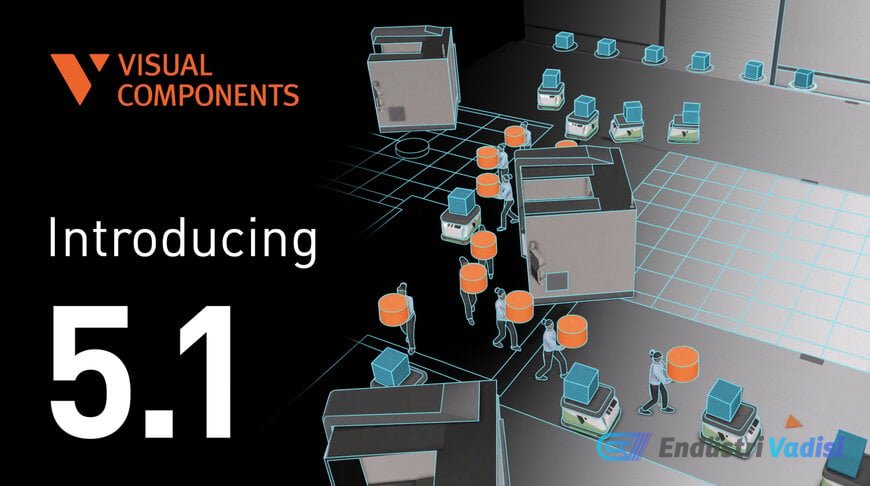
✨ New Era in Large-Scale Autonomous Factory Simulation
Visual Components has launched Visual Components 5.1, a 3D manufacturing simulation and offline robot programming platform designed to validate complex autonomous factory operations before physical setup. This new version simulates hundreds of AMRs and AGVs with collision avoidance, 10 times faster performance, realistic physics, and expanded connectivity features.
🤖 Multi-Agent Fleet Orchestration and Physics Engine Upgrades
Industrial facility planning now requires the simultaneous management of articulated industrial robots, automated guided vehicles (AGVs), autonomous mobile robots (AMRs), manual workstations, and material handling conveyors. Simulating these environments in isolation can overlook bottlenecks, vehicle queue delays, and kinematic path interactions.
The 5.1 architecture introduces an updated PhysX physics engine integration to accelerate dynamic collision detection and rigid body mechanics. The upgraded simulation core supports hundreds of AGVs and AMRs working together with dynamic obstacle avoidance algorithms in a single factory scene, providing ten times faster processing speed compared to previous versions. Mika Anttila, CTO of Visual Components, states that the operational complexity in flexible manufacturing has outpaced traditional toolsets, and the platform allows engineering teams to validate interactions between hundreds of moving kinematic resources, mobile vehicles, products, and personnel before physical hardware is commissioned.
🔌 Controller Emulation and Programming Environment Transition
To support hardware-in-the-loop (HIL) and software-in-the-loop (SIL) virtual commissioning workflows, this release expands direct connectivity to industrial control platforms. The software integrates native driver connectivity for Allen-Bradley programmable logic controllers (PLCs) from Rockwell Automation, enabling automation engineers to directly connect external ladder logic to simulated sensors, actuators, and plant mechanisms. Additionally, custom virtual commissioning add-ons have been added to reflect vendor-specific motion kinematics and joint limits for Nachi and Epson industrial manipulators.
For custom application development and robotic path sequencing, the internal development interface is transitioning from legacy execution scripts to Python 3. The modernized runtime environment offers development teams standardized language syntax, broader access to standard modular libraries, and faster script execution when writing custom behavioral components, kinematic solvers, and material routing routines.
🔍 Technical Comparison: Competitors and Visual Components 5.1
Virtual commissioning and discrete event manufacturing simulation platforms are often evaluated in terms of physical accuracy, PLC communication latency, multi-robot kinematic accuracy, and real-time execution capability. Key industrial platforms in this sector include Siemens Tecnomatix Process Simulate, Dassault Systèmes DELMIA, and Rockwell Automation Emulate3D.
- Siemens Tecnomatix Process Simulate: An enterprise-level digital manufacturing solution deeply integrated into high-volume automotive production. It utilizes the Siemens High-Speed Simulation kernel and direct connectivity to physical and software PLCs via Siemens S7-PLCSIM Advanced and the OPC UA standard.
- Dassault Systèmes DELMIA: Operates on the 3DEXPERIENCE platform and directly integrates engineering CAD data with manufacturing process planning and human ergonomics simulations.
- Rockwell Automation Emulate3D: Focuses on high-throughput material handling, sortation system mechanics, and dynamic conveyor routing.
Visual Components 5.1 combines discrete event material flow modeling with vendor-agnostic 3D robotic offline programming, offering unified AGV fleet orchestration with multi-vendor controller add-ons (Nachi, Epson, KUKA, ABB) on a single desktop platform.





















