








Alper Aktaş
Endüstri Vadisi
- Thread Author
- #1
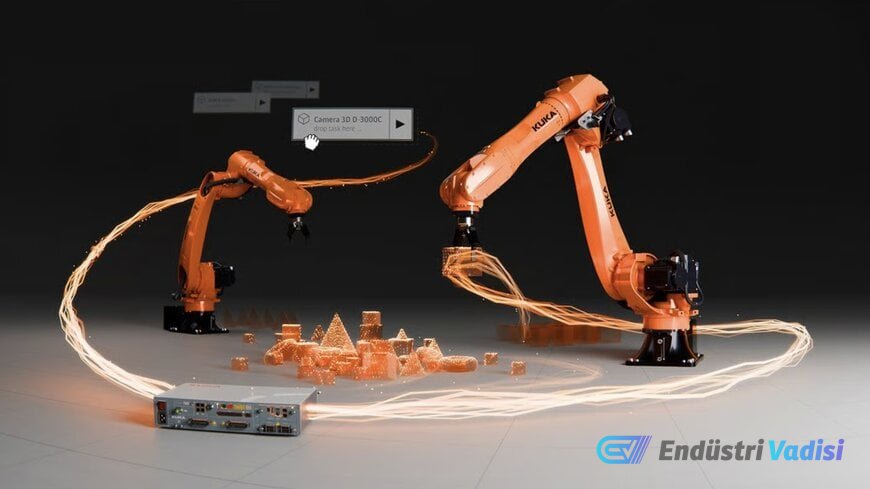
🚀 A New Era in Manufacturing: Digital Twins and AI Integration
Modern industrial manufacturing demands high flexibility, short cycle times, and adaptive automation capable of adjusting to real-time physical changes. In the past, factory design and robot deployment were disconnected. However, KUKA and Visual Components are integrating NVIDIA Omniverse and Jetson architectures to bring together factory simulation, intelligent vision perception, and production line automation.
✨ Real-Time Digital Twin Simulation: FactoryLens
Visual Components introduced FactoryLens at NVIDIA GTC Berlin. This integrated visualization window transforms standard production simulations into photorealistic digital twins. Developed with NVIDIA Omniverse libraries, FactoryLens enables real-time rendering, material property management, and cinematic video capture without the need to export CAD models to external rendering tools. Through bidirectional data exchange using Universal Scene Description (OpenUSD), manufacturing engineers can transfer detailed factory configurations to external digital twin platforms. This allows for verification of cycle times, prevention of robotic collisions, and optimization of material flow.
👁️🗨️ Edge Perception: iiQKA.AI Vision
KUKA introduced iiQKA.AI Vision to translate simulation data into adaptive production action. Powered by the NVIDIA Jetson Orin system-on-module, this AI vision platform provides physical perception directly at the machine controller level. By running deep learning perception models on the robot controller, iiQKA.AI Vision enables robots to recognize components with uncertain orientations, compensate for geometric part variations, and interpret unstructured visual scenes in real time. This integrated vision processing reduces the need for specialized part feeding mechanisms, extending robotic automation to tasks such as quality control, bin picking, and dynamic assembly.
🔗 Orchestrating Physical AI: KUKA AMP
To connect virtual planning with physical execution, KUKA has deployed its Automation Management Platform (KUKA AMP). KUKA AMP functions as an open, modular software architecture that integrates, monitors, and manages heterogeneous automation assets such as autonomous mobile robots, six-axis manipulators, and automated material handling lines. Working in coordination with FactoryLens digital twins and iiQKA.AI Vision edge nodes, KUKA AMP collects live production telemetry to optimize asset utilization and support adaptive factory workflows. This enables facilities to transition from rigid deterministic lines to intent-driven Physical AI operations.
⚙️ Technical Details and Comparisons
- In industrial automation software standards, factory simulation workflows are governed by standards such as ISO 10303 (STEP AP242) and OPC Unified Architecture (OPC 40001-1).
- Visual Components' implementation of OpenUSD via the Omniverse Hydra rendering architecture allows for multi-layered material definitions (MaterialX) and physics-based ray tracing in complex multi-robot assembly facilities.
- KUKA's integration of the NVIDIA Jetson Orin module into its iiQKA OS and KR C5 controller platform offers superior performance compared to competitors like Fanuc (CRX series with iRVision), ABB (OmniCore controllers with integrated Cognex vision), and Yaskawa (YRC1000 with MotoSight).
- The Jetson Orin architecture provides sparse INT8 tensor performance of up to 275 trillion operations per second (TOPS) over unified memory, enabling convolutional neural networks and transformer vision models to calculate real-time six-degrees-of-freedom grasp poses and trajectory offsets within the controller's deterministic motion loop.























