







Semih Asil
Industry Valley
- Thread Author
- #1

While manufacturers hold differing views on the impact of artificial intelligence (AI) in industrial production, there is a consensus on the technology's overall potential. According to a new report, this distinction becomes even more pronounced as companies continue to adopt AI and transition to production-based applications.
─────────────────────────
📊 AI's Impact: Transformative or Experimental?
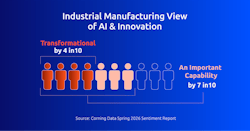
Over 40% of participants describe AI's impact as "transformative," while 57% fall into different categories. Of this group, 29% consider AI important but not a primary growth driver, 15% view it as a strategy to avoid falling behind, and 9% find it experimental.
These findings come from the 2026 Sentiment Report by Corning Data, an IT consulting firm. The report was compiled using data from over 250 manufacturers across the US and two Canadian sources operating in North America.
Statistics from the National Association of Manufacturers (NAM) also support Corning Data's findings. 40% of NAM members believe in AI's potential, a significant increase from just 10% two years ago in 2024.
─────────────────────────
⚙️ AI Adoption Motivations Are Changing
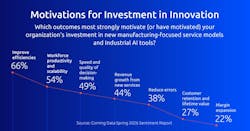
The Corning Data report reveals that 66% of participants cite improved efficiency as the most compelling reason to make additional investments in industrial AI. Efficiency and revenue, new production-oriented service models, and investing in AI tools are among the primary motivations.
However, the report also notes that approximately 60% of participants do not consider industrial AI indispensable for their businesses.
This situation may stem from challenges faced by manufacturers, such as supply chain uncertainties, the turmoil created by Donald Trump's tariffs, and the increasing rate of cyberattacks in the manufacturing sector. Additionally, manufacturing companies face high risks of failure when adopting AI agents.
A common theme highlighted in the report is that AI projects are more likely to fail when treated solely as IT initiatives.
─────────────────────────
🧑💻 AI Views Differ by Job Function
The report also states that opinions on the importance of industrial AI vary according to job functions and roles.
[]54% of C-level executives describe industrial AI as transformative, with similar levels in IT roles (54%) and leadership positions (50%).
[]However, only 37% of participants working in operations share this view, while 23% of those in finance functions hold this opinion.
─────────────────────────
💰 Cost and Timing Factors
Cost is an additional factor determining companies' willingness to prioritize AI innovation. The Corning Data report reveals that costs, funding prioritization, and willingness to change operating models are the issues that most hinder progress and long-term success.
Over 80% of manufacturers surveyed by Corning Data state that they budget 1% to 2.5% of their sales revenue for innovation. This rate aligns with industry standards, which indicate that mature manufacturing firms allocate 1% to 3% of their revenue to innovation.
Timing is also a significant factor. Approximately 80% of participants say initiatives are making progress, but half say progress is slow but steady. About 80% have a timeframe of three to 12 months, with a significant portion determining effectiveness within three to six months. However, smaller companies express greater urgency; small industrial manufacturing firms, including start-ups, are more likely to have tighter timelines and financial constraints for their business and innovation plans.
Among the factors motivating manufacturers to adopt AI, over 50% of participants cite efficiency and productivity, followed by the speed and quality of decision-making.
John Walczak, Chief Architect at Corning Data, says, "Innovation and technology, when they work as intended, create solutions, solve problems, and generate opportunities in business. But this doesn't happen magically overnight. Finding solutions requires planning, commitment, patience, and flexibility."