




Hasan S. Cemkan
Corporate
- Thread Author
- #1
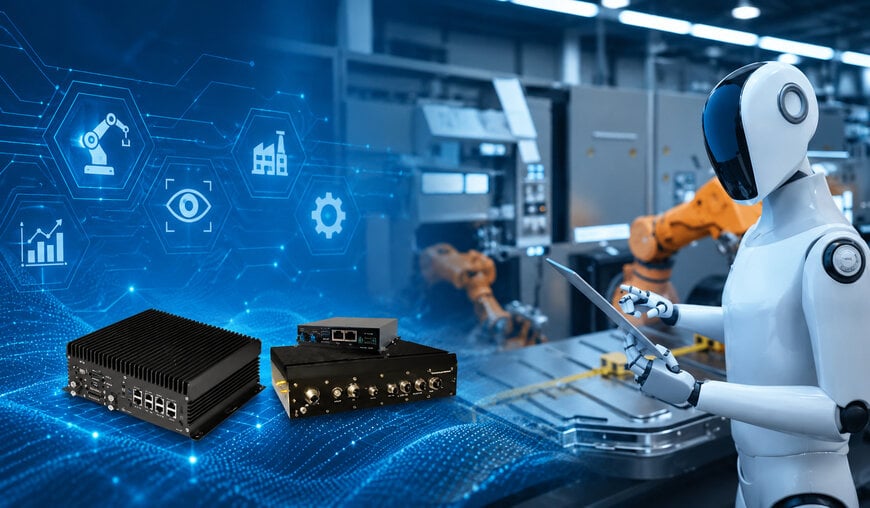
In modern manufacturing facilities, the need for real-time intelligence has become key to operational efficiency. To minimize data latency, reduce equipment downtime, and optimize quality control metrics, computational workflows are shifting from centralized cloud architectures to direct machine interfaces. This transformation opens the door to a new era in industrial automation.
─────────────────────────
💡 Real-Time Intelligence: Why is it Moving to the Edge?
Making instantaneous decisions on production lines is fundamental to gaining a competitive advantage. Therefore, moving artificial intelligence (AI) and machine learning (ML) inferences directly to the production floor, or "the edge," is critically important. This approach eliminates data transmission delays, enabling machines to respond faster and more autonomously.
─────────────────────────
⚙️ Robust Hardware: The New Heroes of the Factory Environment
SINTRONES Technology has announced rugged hardware configurations designed for machine vision and automated equipment management to meet this need. These systems offer powerful processing hardware capable of continuous machine learning inference and synchronizing multi-axis equipment control even in harsh factory environments.
─────────────────────────
🔌 Low Power Consumption and High Performance: Two-Pronged Solutions
[]Ultra-Compact Control Units: Designed for real-time equipment control, process synchronization, and factory connectivity, these units utilize Intel Processor N-series architectures. With low power consumption and fanless operation, they provide seamless integration even in narrow control panels.
[]High-Performance Image Processing Platforms: For intensive analytical tasks such as visual inspection and defect detection, 14th Gen Intel Core processors and discrete NVIDIA RTX graphics processing units (GPUs) are combined. This infrastructure accelerates automated optical inspection workflows in semiconductor manufacturing and precision validation lines.
─────────────────────────
🔒 Cybersecurity and Industrial Standardization: Secure Automation
Increased factory connectivity also brings operational technology (OT) security vulnerabilities. Therefore, integrating security protocols directly into the hardware lifecycle is essential. By strictly adhering to the IEC 62443-4-1 Secure Product Development Lifecycle standard, cybersecurity validation processes are incorporated into the design, development, system testing, and long-term maintenance phases. This allows industrial operators to scale AI automation securely.
─────────────────────────
🔬 Technical Details: Thermal Management and Performance Comparison
Deploying edge computing hardware in industrial automation requires careful consideration of factors such as thermal management, power efficiency, and processing throughput. Ultra-compact control units utilize x86 architecture processors operating within a 6 to 15-watt thermal design power (TDP) envelope and are optimized for fanless deployment in ambient temperatures up to 60 degrees Celsius.
High-performance image processing platforms, on the other hand, combine hybrid CPU architectures and discrete GPUs with TDPs ranging from 35 to over 150 watts. This necessitates advanced active or heat pipe passive cooling mechanisms to prevent thermal throttling during continuous matrix multiplication operations in image processing.
Compared to alternative industrial edge computing platforms such as ARM-based tensor processing modules or custom application-specific integrated circuits (ASICs), the combination of x86 and discrete GPUs offers broader compatibility with established machine vision libraries like OpenCV and proprietary industrial automation software stacks. While dedicated neural processing units may exhibit higher power efficiency per tera operations per second (TOPS) for specific deep learning models, high-performance Intel and NVIDIA architectures provide the high-order processing speeds and raw double-precision floating-point performance required to simultaneously handle real-time PCIe frame capture, deterministic input-output control loops, and multi-stream convolutional neural network inference without frame drops.
─────────────────────────
🎯 Conclusion: The Future of Smart Factories
Edge AI systems are shaping the future of industrial automation by standardizing real-time intelligence in manufacturing facilities. These technologies increase efficiency, reduce downtime, and improve quality control, while also minimizing cybersecurity risks. Smart factories are becoming more autonomous, more secure, and more productive with these integrated solutions.