





Süeda Asil
Corporate
- Thread Author
- #1
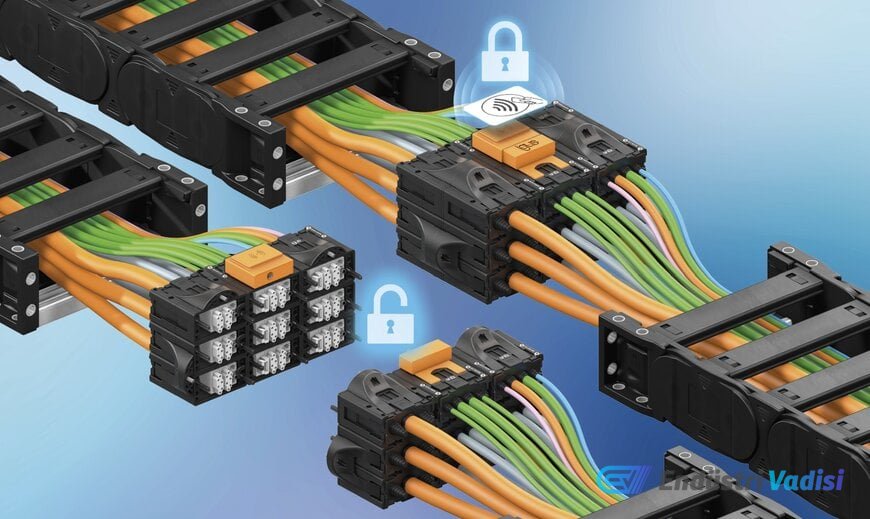
The critical connections at the heart of industrial automation are now more secure! igus has introduced an RFID-based authentication system for modular cable interfaces. This innovative solution guarantees operational continuity by monitoring physical access events and preventing unauthorized disconnections in industrial facilities.
─────────────────────────
💡 Secure Access with RFID: How Does It Work?
Designed to secure high-density power and data interfaces in heavy industrial environments, this specialized radio frequency identification (RFID) locking mechanism can be easily retrofitted into existing multi-cable interface slots. This hardware, requiring no special installation tools, processes authentication requests from authorized personnel cards via an integrated microcontroller.
Upon successful authentication, the system retracts a mechanical metal pin to provide physical access to the connection points. This digitizes physical access to sensitive power supply and data nodes, allowing each access event to be recorded. This data retention capability offers verifiable transparency to maintenance engineers for service schedules, incident documentation, and quality control operations.
─────────────────────────
⚙️ Integration and Hardware Locking Mechanisms
In complex production facilities, unauthorized interventions in power supply connections during critical operations can frequently lead to prolonged downtimes and costly service interventions. igus's RFID lock functions as a retrofittable hardware that can be directly attached to existing modular cable systems to address these security vulnerabilities.
This system represents a shift from physical key management and external lockout-tagout devices to localized digital authorization. Thus, automated facilities can locally control and record physical connector tampering instead of relying on manual inspection protocols.
─────────────────────────
⚡ High-Density Interface Consolidation
The core hardware architecture of this system allows technical personnel to group 16 or more different transmission lines (including electrical power, data bus, fiber optics, and pneumatic hoses) into a single modular interface. By combining separate connectors into a single consolidated module that can accommodate up to four interchangeable inserts, the system eliminates multiple individual connection steps.
Technical evaluations indicate that this consolidation can reduce total assembly time by up to 80%. Furthermore, physically combining these connections within a single housing reduces the risk of polarization or reversal errors during rapid maintenance cycles. The high-density housing ensures that these multi-format interfaces can be deployed in machine configurations where spatial constraints limit the applicability of standard industrial terminal blocks.
─────────────────────────
📊 Competitive Perspective
In the industrial connector market, manufacturers often secure high-density modular interfaces using mechanical housings, padlock brackets, or secondary mechanical latches. Competing systems like the Harting Han-Modular series rely on robust mechanical latching mechanisms to ensure structural connection integrity, but traditionally lack integrated digital authentication at the individual connector level.
igus's integration of a microcontroller-controlled RFID locking pin directly into the connector housing shifts the standard from strict mechanical security to integrated digital access control. This signifies a significant paradigm shift in industrial security.
─────────────────────────
This innovation from igus elevates connection security in industrial facilities to a higher level, enhancing operational efficiency while strengthening data integrity and system security. In our digitized world, bringing physical access under digital control is a critical step for the future of smart factories.