








Cengiz Özemli
Academic
- Thread Author
- #1
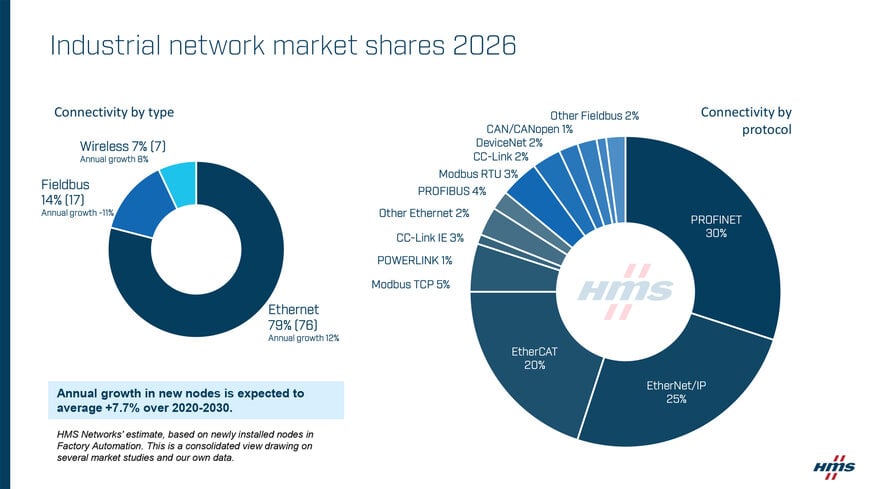
The balance of power in the world of industrial automation is shifting! HMS Networks' latest analyses reveal the undisputed leadership of Industrial Ethernet in factory networks. So, what are the underlying dynamics behind this transformation, and what awaits us in the future?
─────────────────────────
📈 Market Stability and Growth Expectations
Following the slowdown in 2024, 2025 was a period of recovery and stability for the market. Component supply chains normalized, and inventory cycles in the automation sector largely completed. While the automotive sector in Europe faced some challenges, overall manufacturing activity recovered, and capital expenditures on new automation projects accelerated again in most regions.
HMS Networks' 2026 research confirms an average annual growth expectation of 7.7% in newly installed nodes over the next five years. The main driving force behind this growth is the ongoing transition from existing Fieldbus-based systems to Industrial Ethernet.
─────────────────────────
🌐 Industrial Ethernet: 79% of New Installations
According to the 2026 analysis, Industrial Ethernet now accounts for 79% of new installations, up from 76% in 2025. The top three Ethernet protocols further solidified their positions, representing approximately three-quarters of the wired protocol market.
[]PROFINET strengthened its leadership to 30% (previously 27%).
[]EtherNet/IP follows with 25% (previously 23%).
[]EtherCAT continues its strong ascent with 20% (previously 17%).
[]Modbus TCP remained stable at 5%.
[]CC-Link IE maintained its stable course at 3%.
[]POWERLINK declined to 1% (previously 3%).
[]Other Ethernet protocols make up the remaining 2% as market consolidation around larger networks continues.
─────────────────────────
📉 Fieldbus Technologies Decline: Down to 14%
Fieldbus technologies now represent 14% of new nodes, down from 17% in 2025. PROFIBUS & PROFINET International's own published figures show that PROFIBUS new node installations fell from 1.1 million in 2024 to 1.0 million in 2025; this 9% decline is also confirmed by HMS Networks' internal data and industry surveys.
[
- ]PROFIBUS remains the largest Fieldbus but declined to 4% (previously 5%).
[]Modbus RTU remained stable at 3%, maintaining its role as a universal low-cost serial protocol.
[]CC-Link, DeviceNet, and CAN/CANopen each remain in the 1-2% range, showing modest declines.
[]Other Fieldbus protocols collectively make up 2% (previously 4%) as the long tail of legacy networks fades.

─────────────────────────
📡 Wireless Networks: Stable at 7%
Wireless technologies continue to account for 7% of new node installations, unchanged since 2025. Wireless continues to complement wired industrial networks, especially for mobile equipment such as AGVs (automated guided vehicles) and AMRs (autonomous mobile robots), modernized machines, and IIoT (Industrial Internet of Things) sensors in hard-to-reach locations.
5G remains a significant area of interest, but its adoption in the industrial sector is progressing slowly. The complexity of private 5G infrastructure stands out as the most frequently cited obstacle. While early industrial 5G deployments continue to grow, particularly in Asia, the technology has not yet delivered the groundbreaking adoption many in the industry expected.
─────────────────────────
🌍 Regional Perspectives
[
- ]Europe: PROFINET and EtherCAT maintain their leadership. Strong activity is observed around APL (Advanced Physical Layer) for process automation and SPE (Single Pair Ethernet) for sensor-level connectivity. The decline of PROFIBUS is most pronounced in Europe, as its installed base is the largest here, and the transition to PROFINET is most advanced.
[]North America: EtherNet/IP remains the dominant protocol, especially in automotive and discrete manufacturing. The adoption of IO-Link, APL, and SPE is gaining momentum, supported by interest in OT cybersecurity ahead of the regulatory environment shaping around CRA and IEC 62443.
[]Asia: PROFINET and EtherCAT continue to grow in the Chinese market. CC-Link IE, the first industrial protocol with TSN (Time-Sensitive Networking) mechanism, maintains its strong regional position.
─────────────────────────
💡 HMS Networks' Perspective: Beyond Protocols
Magnus Jansson, Product Marketing Director at HMS Networks, states, "Twelve years of data tell a surprisingly consistent story. The shift from Fieldbus to Industrial Ethernet is now in its final stages, but the more interesting question is what comes next. When almost everything is Ethernet, the conversation shifts from 'which protocol?' to 'what runs on it?': functional safety, cybersecurity, TSN, OPC UA, Single Pair Ethernet, IT/OT convergence. Complexity and differentiation will increasingly concentrate at these points."
Jansson further adds, "The 2026 figures also reinforce something we've seen in our industry survey: cybersecurity is now cited as the biggest integration challenge by almost half of the participants, and 93% expect OT cybersecurity to change significantly in the next five years. Protocols are important, but the layers on top of them increasingly determine how factories actually operate."
─────────────────────────
📚 A Broader Look at Industrial Networks
To complement its annual market share analysis, HMS Networks also publishes an expanded report, "The State of Industrial Networks," which examines broader dimensions shaping industrial communication (cybersecurity, leading industry voices worldwide, regional or sector-specific dynamics, and much more).
This expanded report draws on the "Future of Industrial Networks" survey, now in its second year and an externally paneled study. The 2026 cycle collected responses from industrial designers and users across all major regions and industries. As individual protocol-level changes become smaller year-on-year, the broader picture captured in the expanded report will increasingly drive the conversation about where industrial networks are heading.
─────────────────────────
🔬 About the Study
The HMS Networks analysis is based on a combination of market insights, internal data, and input from key stakeholders in the industrial automation sector. The study focuses on newly installed nodes in factory automation worldwide; each node is a device or machine connected to an industrial control network. This is the twelfth year HMS Networks has published this annual analysis.
In summary, the future of industrial automation is being built on the solid foundations of Industrial Ethernet. However, the real difference will be made by the layers built upon this foundation, such as cybersecurity, real-time communication, and IT/OT integration. Our factories are becoming not only faster but also more secure and intelligent.




















