






Elif Özaksu
Corporate
- Thread Author
- #1
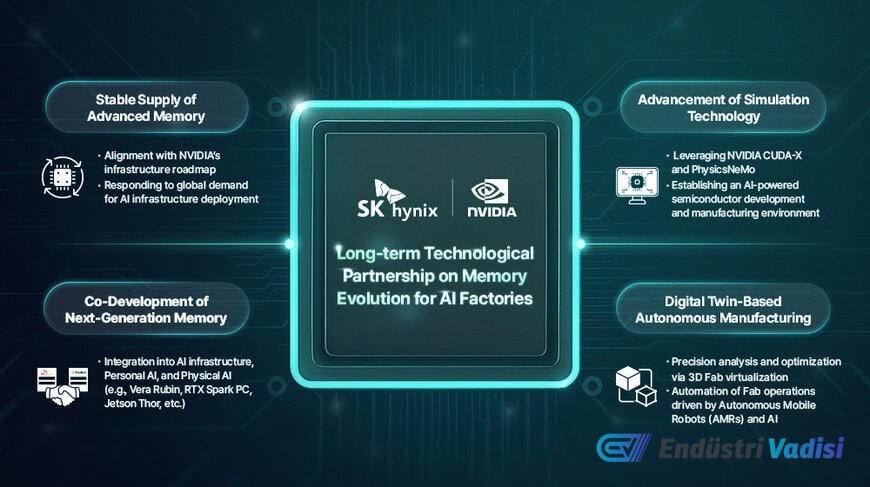
In the age of artificial intelligence (AI), data processing capacity and speed have become key to competitiveness. In this context, the multi-year technology collaboration between SK hynix and NVIDIA is opening the doors to a new era in the industry. This strategic partnership formalizes the joint development of next-generation memory architectures optimized for high-density computing clusters.
This collaboration is critically important for the sustainability of hardware supply chains, which require long development processes, complex manufacturing stages, and high capital investments.
─────────────────────────
⚙️ Joint Engineering in Hardware Domains and Digital Supply Chain Nodes
Scaling computing clusters suitable for modern machine learning (ML) workloads requires extreme synchronization between the graphics processing architecture and memory layers. To reduce connection friction in the digital supply chain, the technical framework encompasses high-performance enterprise systems, decentralized edge devices, and personal computing hardware.
The joint development process targets memory subsystems in specific deployment nodes such as Vera Rubin AI supercomputers, Vera central processing units, RTX Spark personal computers, and Jetson Thor robotic computing platforms.
This deep physical integration marks a transition from traditional component sourcing to an early-stage hardware co-design model. By matching the physical limits of high-bandwidth memory with the full transmission speeds of next-generation processor silicon, the unified architecture addresses memory bandwidth constraints imposed by localized edge model training. This structural reliability is essential to support multi-layered real-time data ingestion across expanding enterprise monitoring assets and autonomous industrial nodes.
─────────────────────────
🔬 AI-Powered Computational Lithography and Autonomous Manufacturing Digital Twins
The operational scope of the partnership utilizes specialized software libraries to optimize internal semiconductor manufacturing lines. Engineers implement CUDA-X computing libraries alongside the PhysicsNeMo framework to perform high-fidelity physical simulations and technology computer-aided design (TCAD) workflows.
This integration enables rapid acceleration of in-house engineering codes, reducing the computational time required to model electronic design automation (EDA) topologies and complex lithographic patterns.
Concurrently, factory automation is progressing towards fully autonomous wafer production with the deployment of operational digital twins. Using Omniverse visualization libraries and OpenUSD data pipelines, manufacturing environments are modeled into real-time 3D virtual spaces. To optimize in-factory logistics, the platform coordinates the routes of autonomous mobile robots and hardware delivery systems in the live production area using the GPU-accelerated cuOpt decision engine and the Metropolis platform.
This collaboration represents a critical step in developing high-performance and efficient memory solutions required by the age of artificial intelligence. The future of AI infrastructure will be shaped by such integrated approaches.