






Erkan Teskancan
Corporate
- Thread Author
- #1
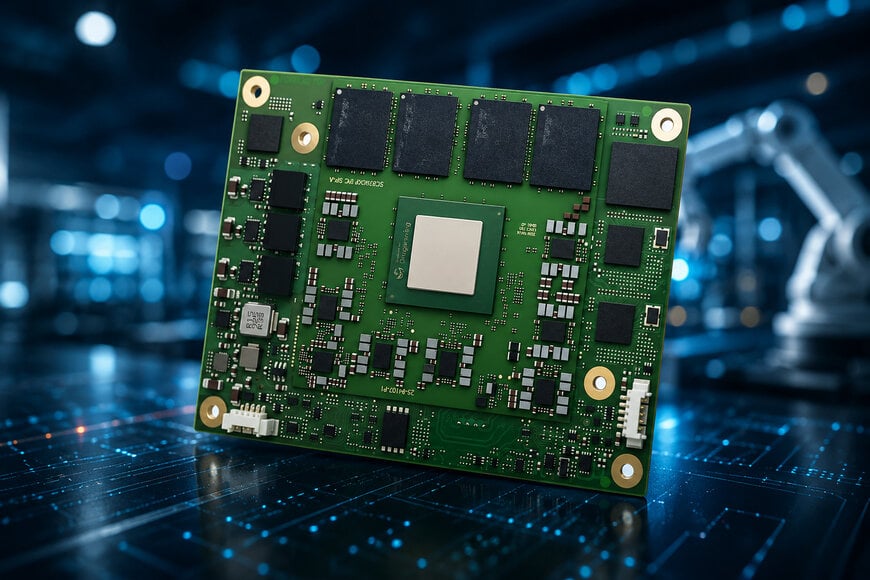
Industrial automation, artificial intelligence, and machine learning applications are among today's most dynamic and demanding fields. To meet the needs in this area, the congatec conga-HPC/mIQ-X module has been introduced by Aaronn Electronic. This compact yet powerful module ushers in a new era for edge AI and industrial embedded systems.
─────────────────────────
⚙️ Heterogeneous ARM Architecture for Edge AI
The conga-HPC/mIQ-X is based on Qualcomm Dragonwing IQ-X processors. These processors feature up to twelve Qualcomm Oryon CPU cores operating at frequencies up to 3.4 GHz. The Qualcomm Hexagon NPU, which boosts AI performance to its peak, delivers up to 45 TOPS (Trillion Operations Per Second) of AI performance, while the Adreno GPU complements this architecture for graphics-intensive applications.
This heterogeneous architecture enables the CPU, GPU, and NPU to process different workloads simultaneously. Thus, tasks such as AI inference, image processing, and sensor data analysis can be performed directly on the module. This integration eliminates the need for external accelerator cards, reducing system complexity and thermal design challenges.
The module features 16 GB to 64 GB of soldered LPDDR5x memory, supporting data rates up to 8400 MT/s. Additionally, up to 1 TB of integrated UFS 4.0 storage offers an ideal solution for data-intensive applications with fast boot times and low-latency data access.
─────────────────────────
📏 COM-HPC Mini for Compact High Performance
The conga-HPC/mIQ-X adopts the standard COM-HPC Mini form factor, measuring 95 x 70 mm. This compact size facilitates the module's integration into various applications such as space-constrained industrial PCs, mobile systems, autonomous platforms, and industrial edge gateways. The COM-HPC standard supports modular platform strategies, enabling interchangeable processor generations and long-term product availability.
The COM-HPC specification is designed for applications requiring high computing performance and extensive I/O capabilities. Compared to previous computer-on-module standards, COM-HPC offers significantly more PCIe lanes, modern high-speed interfaces, and greater scalability for edge servers and high-performance embedded platforms.
─────────────────────────
⚡ High-Speed I/O and Industrial Network Connectivity
To support high-performance peripherals, the module provides up to 16 PCIe lanes, including PCIe Gen4. This allows for the integration of FPGA cards, NVMe storage devices, frame grabbers, and additional expansion modules. The system also supports up to two USB4 interfaces for bandwidth-intensive external devices.
For networking applications, the module integrates dual 2.5 Gigabit Ethernet ports with IEEE 1588v2 and MACsec support. Precise time synchronization enables deployment in industrial communication environments requiring deterministic data transfer, while MACsec enhances network-level security.
For imaging applications, MIPI-CSI interfaces allow direct connection of camera systems. CAN, I2C, SPI, UART, GPIO, and other embedded connectivity options enable the integration of sensors, actuators, and industrial control systems.
─────────────────────────
🔒 Industrial Security and Long-Term Availability
The conga-HPC/mIQ-X includes a TPM 2.0 module that functions as a hardware root of trust. Features such as Secure Boot, encrypted storage areas, and protected firmware processes support cybersecurity strategies for industrial edge systems and connected manufacturing environments.
The specified operating temperature range of -40°C to +85°C makes the module suitable for deployment in industrial environments with varying climatic conditions. Hardware health monitoring, watchdog functionality, and power loss control further support robust designs for stationary and mobile applications.
At the software level, the module supports Linux distributions, including Ubuntu Pro and Yocto, as well as Windows 11 IoT Enterprise LTSC. This flexibility allows developers to integrate the platform into existing software ecosystems while meeting long-term product lifecycle requirements.
─────────────────────────
🏭 Edge AI for Machine Vision, Robotics, and Industrial Automation
This module addresses a wide range of industrial applications. In factory automation environments, AI models can locally analyze production and sensor data to support predictive and condition-based maintenance. The platform's memory bandwidth enables parallel processing of multiple data streams.
For machine vision systems, the combination of ISP, GPU, and NPU accelerates image classification, quality control, and object detection directly at the edge. Manufacturing operations can benefit from reduced latency and local decision-making capabilities.
In robotic applications, the architecture supports navigation algorithms, simultaneous localization and mapping (SLAM), and sensor fusion. LiDAR, camera, and IMU data can be processed on a single platform, reducing the need for external computing resources.
The module is also suitable for industrial edge servers and gateways that perform data collection, preprocessing, and secure transmission to cloud infrastructures. Dual 2.5 GbE connectivity supports redundant network architectures in distributed industrial facilities.
─────────────────────────
📊 Market Position and Competitive Advantages
The conga-HPC/mIQ-X, with up to 45 TOPS of AI performance, is positioned among high-performance edge AI platforms designed for local inference processing. Unlike many traditional ARM-based embedded modules, this platform combines CPU, GPU, DSP, and NPU resources within a standard COM-HPC Mini module.
The COM-HPC Mini standard provides higher I/O density and long-term scalability compared to many proprietary edge AI platforms. For OEMs, separating the carrier board from the compute module allows for the reuse of existing hardware designs when upgrading to future processor generations.
The combination of up to twelve Oryon CPU cores, 64 GB LPDDR5x memory, PCIe Gen4, USB4 connectivity, and an industrial operating temperature range addresses applications with demanding requirements for data processing, networking, and AI inference at the edge. Through this platform, congatec expands the COM-HPC ecosystem with an ARM-based solution specifically designed for industrial edge computing and embedded AI deployments.