






Semih Asil
Industry Valley
- Thread Author
- #1
A New Era in Industrial Robotics with FANUC and NVIDIA! 🤖🚀
A groundbreaking development is underway in the world of industrial robots! FANUC and NVIDIA are strengthening their collaboration in robot simulation and AI integration, taking industrial automation to the next level. This innovative partnership holds the potential to revolutionize manufacturing processes.
─────────────────────────
💡 Bridging from Simulation to Reality
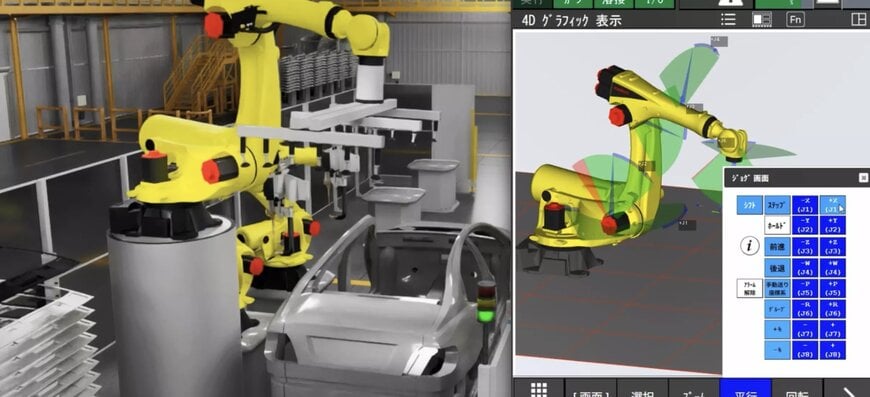
FANUC and NVIDIA have deepened the integration between NVIDIA Isaac Sim and FANUC's own simulation software, ROBOGUIDE. This collaboration brings together advanced simulation architectures and foundation models to enhance the accuracy of digital twins for industrial robots. The goal is to close the gap between simulation and the real world and to automate variable manual tasks.
─────────────────────────
⚙️ Technical Architecture and Software Integration
The foundation of this collaboration is the bidirectional integration of the NVIDIA Isaac Sim and FANUC ROBOGUIDE software suites. Within this technical framework, responsibilities are distributed among software layers according to engineering functions:
[]FANUC: Provides robot motion control algorithms, cycle time calculators, virtual teach pendants, and 3D Vision system processing capabilities.
[]NVIDIA: Offers the Isaac Sim framework, the PhysX physics engine, the Isaac Lab learning environment, and the GR00T N robot foundation model.
The platform operates in two distinct operational modes. In the first mode, Isaac Sim generates physically accurate sensor environments, while ROBOGUIDE continuously communicates in the background to ensure the same trajectories and execution times as real machines. In the second mode, ROBOGUIDE drives the user interface, while the NVIDIA PhysX engine handles real-time calculations for rigid body dynamics, contact forces, and gravity modeling.
─────────────────────────
🧠 Intelligent Functionality and Operational Logic
The system uses standard digital interfaces to synchronize parallel environments. For instance, in complex tasks like bin picking, randomly stacked parts are simulated through physics-based modeling. FANUC's 3D Vision system scans the virtual pile, determines part coordinates, and validates pick-and-place trajectories through the background physics engine to prevent robot arm collisions or part slippage.
For flexible component handling, such as garment folding, the system bypasses traditional vision-based path compensation. Instead, it utilizes the NVIDIA GR00T N foundation model to process imitation learning data acquired from human operators. FANUC's motion control technology smooths the resulting neural network outputs, converting them into fluid and continuous physical motor currents in real-time.
─────────────────────────
🔬 Field-Tested Reliability
The integrated technologies have successfully passed phased physical and virtual testing cycles. Initial validation was conducted at the International Robot Exhibition in Tokyo, where technical teams confirmed path replication accuracy.
Subsequent architectural upgrades were completed prior to FANUC's New Product Open Exhibition in May 2026. This deployment phase introduced a physical dual-arm CRX collaborative robot system configured with an updated edge computing infrastructure. The system replaced legacy hardware modules with the NVIDIA Jetson Thor platform and the Jetson T5000 module, increasing local AI computing capability by 7.5 times, accelerating real-time human-robot collision avoidance cycles.
─────────────────────────
🏭 Industrial Applications and Efficiency Advantages
Targeted application areas include high-volume automotive assembly, electronics manufacturing, and logistics warehouse sorting. Concrete technical use cases include flexible cable routing simulation, high-precision component placement, and automated bin picking under unstructured conditions.
By implementing this integrated digital infrastructure, facilities achieve higher process stability, safety, and sustainability. The technical rationale for this deployment relies on eliminating physical prototyping; by completing all feasibility and virtual commissioning work within a high-fidelity simulation loop, automation engineers can optimize cycle times and predict mechanical deviations before physical hardware installation on the factory floor.
This collaboration between FANUC and NVIDIA is shaping the future of industrial robots, opening new horizons for efficiency and flexibility in manufacturing.