

Erkan Teskancan
Corporate
- Thread Author
- #1
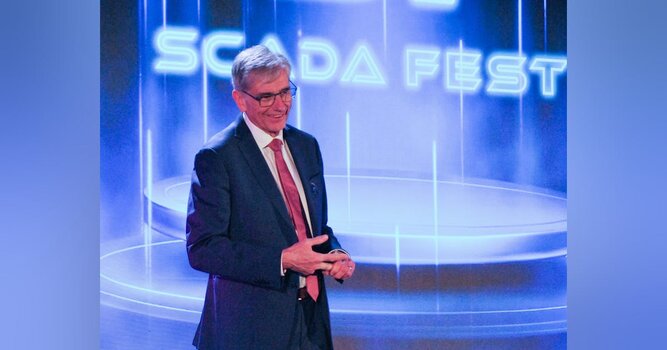
<p>In late March, Orlando hosted a special gathering for users and developers of Trihedral Engineering's VTScada platform. This event not only shared best practices and recent developments but also celebrated the 40th anniversary of the company's SCADA (Supervisory Control and Data Acquisition) software. The ScadaFest conference keynote began with a video showcasing the software's first installation, its application in a water treatment plant in Charlottetown, Canada. This system has been providing remote visibility since 1986, eliminating the need for on-site inspections.</p>
<hr>
<h3>🧠 State Logic: The Cornerstone of VTScada</h3>
<p>Trihedral Engineering President Glenn Wadden states that when he developed VTScada as a project engineer in 1986, he based it on the principles of state logic from his university years. State logic, a unique innovation for software development at the time, remains a distinguishing feature of VTScada today.</p>
<p>According to Wadden, software performance depends on the number of variables in interaction. Classical programming is based on input-process-output, but as data constantly changes, the likelihood of problems increases with the interaction between variables. In fact, complexity can escalate rapidly, as the number of interactions increases proportionally to the square of the number of variables.</p>
<p>However, state logic "focuses on what matters, by only looking at the effects propagated by change." This event-driven approach allows the program to work with fewer variables, in an organized hierarchy. The result is a faster-running, simplified code with fewer errors. Wadden adds, "Performance is no longer dependent on scale, but on how many things are changing."</p>
<hr>
<h3>📈 Continuous Improvement and the Goal of 100% Uptime</h3>
<p>Today, even though VTScada is a system containing 40 million lines of code, the company aims for 100% uptime and minimizing proprietary code that leads to technical debt. Wadden says, "Over the years, we've implemented 13,000 changes and experienced no downtime. When a feature is added, it has to work forever."</p>
<hr>
<h3>🆕 2026 Innovations and Future Vision</h3>
<p>Among the innovations planned for 2026 is the replacement of the application activation server methodology with easier and more understandable methods. Wadden states, "Despite the risk of unauthorized use, we will disable activation servers to make you more productive."</p>
<p>Five years have passed since the company's acquisition by Taiwan-based Delta Electronics, and during this time, Trihedral Engineering has doubled in revenue, employee count, and ScadaFest attendance. Delta's leadership in power electronics contributes to VTScada's innovation.</p>
<p>Trihedral Engineering Vice President Barry Baker states that they are continuously improving VTScada's performance, which means real-time data and protocols, immersive visualization, and interactive design. "But at its core, we're interested in making everything better. Helping others is what we do at Trihedral."</p>
<p>Chief Technology Officer Devraj Sen also shared new VTScada features to be released this year. These include a revamped Report Studio with new user interfaces and layouts, new calculation and SQL data capabilities, and new features in notes and printing.</p>
<p>Other new developments include:</p>
<ul>
<li>Realm page menus (a side benefit of Report Studio enhancements)</li>
<li>High-performance, low-cost Enterprise-grade OPC-UA server</li>
<li>Historical data compression, promising 40% better performance and the ability to expand storage across multiple servers, so historical data can be moved to slower drives.</li>
</ul>
<p>Wadden concludes by saying: "Our main focus in the coming period will be to make it easier to develop and maintain larger systems. And if it's easy to develop and maintain large systems, then small systems will be too."</p>