




Ahmet Ö.
Corporate
- Thread Author
- #1
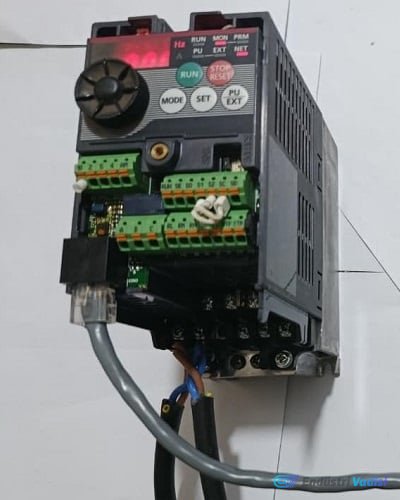
Motor speed control can be complex due to the variety of methods available. Variable Frequency Drives (VFDs) adjust motor speed by changing the frequency of the power supplied to the motor. VFDs can receive speed commands as fixed values, digital or analog signals, or via communication networks. The choice depends on practical factors such as ease of use, operator access, and network infrastructure.
### Fixed Speed Control
Fixed speed control is one of the simplest methods. In drives like the Mitsubishi FR-D700, the motor is run at a pre-set maximum frequency by sending an operation command via digital inputs. Settings are made through internal parameters; maximum and base frequency, as well as acceleration and deceleration times, are determined. This method does not require programming and provides a constant speed, but it is not flexible.
### Multiple Speed Options
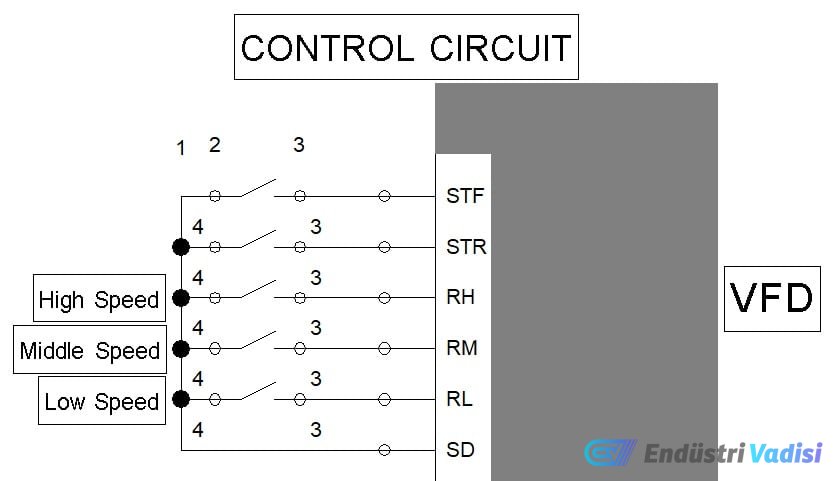
Drives like the FR-D700 support controlling multiple fixed speeds via digital inputs. For example, when different input terminals are activated, the motor can operate at pre-determined low, medium, or high speeds. This allows for the selection of multiple speeds instead of just one fixed speed.
### Local Control
Many VFDs offer local control to the user through their built-in keypad and potentiometer. This method is suitable for operations such as commissioning and troubleshooting, but it is not ideal for automated systems as it requires too much manual intervention.
### Speed Control with Analog Input
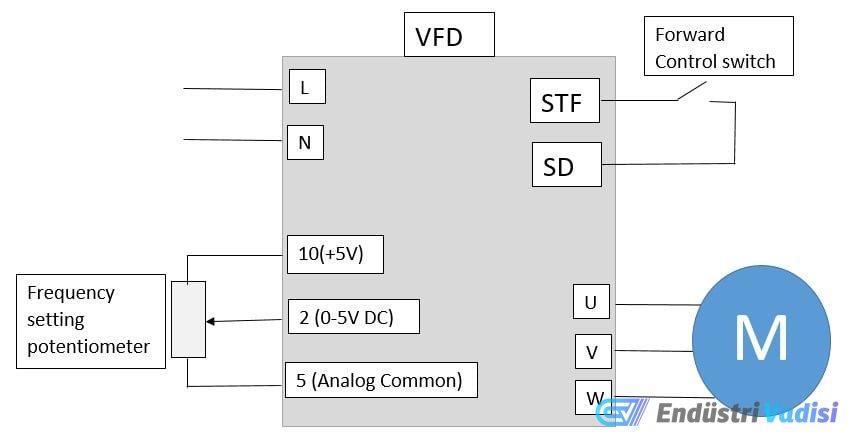
Connecting a potentiometer to the analog input for drive speed control is a common method. Typically, a 0-10 V voltage signal commands the motor's speed. This method provides low-cost, continuous, and smooth speed adjustment, but its accuracy depends on the potentiometer's rotation angle and it can be affected by electromagnetic interference.
### Serial and Industrial Network Systems
Serial communication protocols such as RS-232 and RS-485 enable digital commands to be sent from PLCs and HMIs to the drive. With protocols like Modbus RTU, speed-related settings, motor start/stop, and status information are controlled. Although this method requires complex configuration, it offers multi-drive management and detailed diagnostics.
In recent years, industrial Ethernet protocols (PROFINET, EtherCAT, Ethernet/IP, Modbus TCP) have enabled centralized and high-speed data exchange. These systems are ideal for multi-drive control in large-scale automation projects, but they increase hardware cost and configuration complexity.
### Conclusion
Each VFD speed control method offers different levels of flexibility and complexity. While fixed speed or local potentiometer use may be sufficient for simple applications, PLC-based control or network connections are preferred in systems requiring complex synchronous control. The correct choice ensures that the system is effective and fit for purpose.