Mucitler Elektrik
Corporate
- Thread Author
- #1
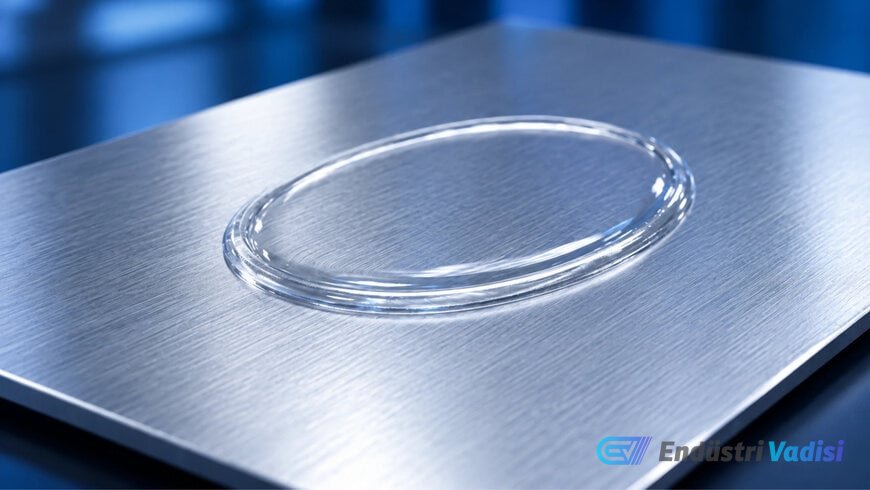
💡 Making Transparent Adhesives Visible: Why Traditional Methods Fall Short?
Automated inspection of adhesive beads, sealants, and transparent resins is a critical task in the electronics, battery, and automotive industries. However, since most of these materials transmit light in the visible spectrum (400-780 nm), adhesives on reflective surfaces like aluminum appear only as faint edges with very low contrast. This poses a significant challenge for traditional machine vision systems.
🔬 The Basler Solution: Deep Ultraviolet (DUV) Imaging
To address this problem, Basler offers an innovative machine vision approach that shifts image acquisition into the deep ultraviolet (DUV) range. This method leverages the different optical behaviors of materials in the DUV range.
🌈 The Miracle of Absorption Contrast at 280 nm
The core of the approach lies in the strong absorption of light by certain adhesives and resins at a wavelength of 280 nm, while aluminum continues to reflect. This makes the adhesive appear dark against a bright background. In Basler's demonstrations, the adhesive was clearly visible under DUV light with a 1 ms exposure time, whereas in white light at 0.4 ms, only vague boundaries could be observed.
📸 The Perfect Harmony of Camera, Optics, and Illumination
Basler emphasizes that DUV illumination alone is not sufficient. The camera, lens, and illumination must be selected together as a system. In this setup, the Basler ace 2 X UV camera is used with the Sony Pregius S IMX487 sensor (200-400 nm sensitivity, 8.1 MP resolution, global shutter). Since standard optical glass absorbs in the UV range, special UV-transmitting lenses and a 280 nm DUV light source are required.
🚀 Process Benefits and Application Areas
Thanks to sufficient contrast, this vision system can verify the presence, distribution, boundaries, and coating of the adhesive layer. Since contrast is achieved from a fixed camera position, system designers need fewer additional lights or viewing angles, which simplifies the mechanical setup and shortens control loops. The same principle can be applied to other transparent resins and glass, depending on their UV absorption and the substrate.
🔍 Additional Information: UV Imaging Methods
In machine vision, UV imaging is generally divided into near UV (315-400 nm) and shorter wavelength UV-C/DUV (below 280 nm). Sony's Pregius S IMX487 sensor is a back-illuminated global shutter sensor optimized for the 200-400 nm band. Alternative methods for transparent material inspection include fluorescence imaging with UV-fluorescent additives and polarization imaging. DUV absorption imaging eliminates the need to modify the adhesive formulation.