





Erkan Teskancan
Corporate
- Thread Author
- #1
💡 Why Edge AI?
Most industrial AI applications cannot rely on the cloud due to reasons such as low latency, limited factory connectivity, and data privacy. However, intensive workloads like deep learning-based image processing or language models exceed the real-time processing capacity of traditional controllers and CPU-based industrial PCs. To meet this need, Rockwell Automation has introduced its GPU-powered industrial computers with NVIDIA accelerated computing power.
⚙️ Two Models, Different Needs
Rockwell Automation's new 6300B-SB1 EdgeAI series offers two distinct models:
- EdgeAI 4000: Equipped with an NVIDIA RTX PRO 4000 Blackwell GPU.
- EdgeAI 2000: Uses an NVIDIA RTX 2000E Ada Generation GPU.
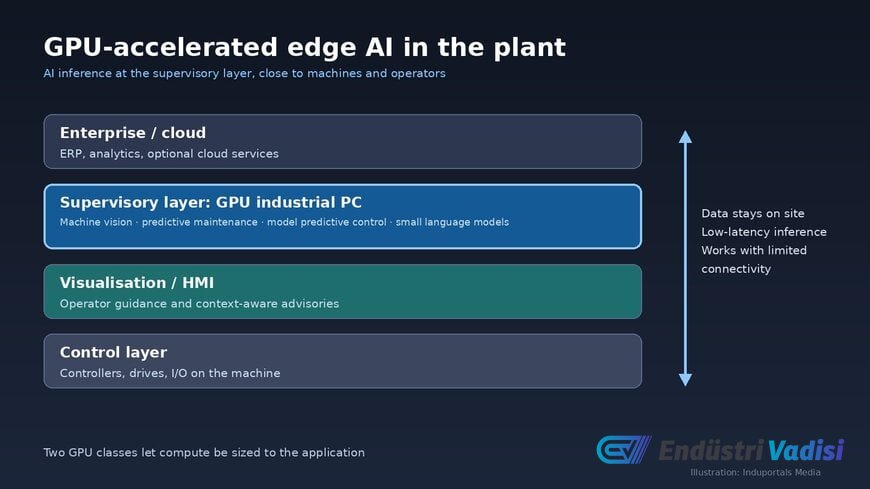
These robust computers are designed for applications requiring more processing capacity at the supervisory layer, above machine control and below enterprise systems.
🎯 AI Workloads at the Supervisory Layer
These systems are ideal for applications such as advanced machine vision, model-predictive control, predictive maintenance, reinforcement learning, and small language models that provide real-time advisory support to operators. They complement existing control, HMI, and visualization products, providing acceleration where the workload demands it.
🔗 Integration with FactoryTalk Optix
Small language models and other compute-intensive applications can run on-premises, integrated with Rockwell Automation's HMI and industrial visualization software, FactoryTalk Optix. This provides low-latency, context-aware guidance to operators and maintenance teams even when cloud connectivity is limited or data needs to remain on-premises.
📈 Operational Benefits
Processing data locally eliminates network latencies from critical inference processes, keeps sensitive process data on-premises, and reduces reliance on external connectivity. The option of two different GPU classes allows engineers to scale hardware to the application; for example, choosing between a single vision cell and a line-level advisory system.
🌐 Position in the ISA-95 Automation Hierarchy
In the ISA-95 automation hierarchy, the supervisory layer sits between real-time control (level 1) and manufacturing operations management (level 3). GPU acceleration at this level has become more common as vision inspection shifts from rule-based algorithms to deep learning models, and small language models are used to interpret alarms, manuals, and maintenance records.