



Hasan S. Cemkan
Corporate
- Thread Author
- #1
Advantech Highlights Industrial AI and Software-Defined Automation at SPS 2026
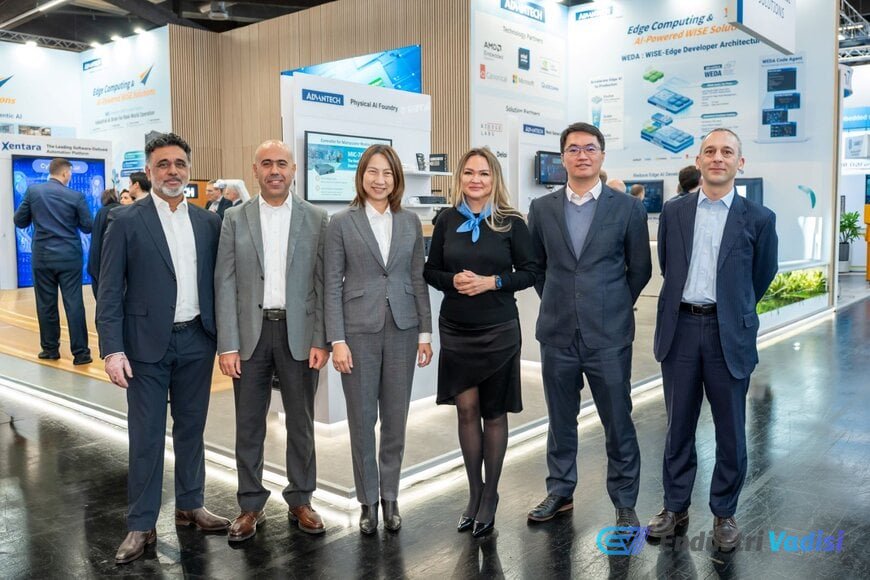
Advantech, a global leader in IoT intelligent systems and embedded platforms, drew attention at the SPS 2026 exhibition in Nuremberg, Germany, with the theme "Driving the Industrial AI Frontier and Software-Defined Automation."
🔍 Accelerating Industrial AI with Three Strategic Pillars
At the exhibition, Advantech showcased an open edge computing architecture built around three main strategic pillars:
- WISE Industrial AI Solutions and IWS (Integrated WISE Solution Station): Positioned as the Industrial AI Brain.
- Edge AI and Physical AI: Moving AI from analytics to physical application.
- Software-Defined Automation: Aims to accelerate the scaling of industrial AI from the development phase to real-world deployment.
📈 Bringing AI to the Factory Floor
Ching-Po Lin, Vice President of Advantech's IoT Automation Sector, stated that the true value of industrial AI lies in delivering measurable and sustainable operational improvements on the factory floor. He emphasized that through the integration of the WISE Industrial AI platform, IWS, and software-defined automation technologies, customers and system integration partners can create industry-specific AI agents. This enables existing machinery, industrial data, and operational workflows to be interconnected, making it possible to scale applications across multiple production lines and facilities.
💡 Solution Areas Exhibited at SPS 2026
Advantech's exhibition brought together AI software development, physical robotics, and open industrial control:
- WISE Industrial AI Solutions: With the WEDA edge intelligence development framework, it facilitates industrial data integration, AI application creation, and cross-platform deployment. Combined with IWS, it enables the creation of domain-focused AI agents for predictive maintenance, energy management, and production optimization.
- Edge AI and Physical AI: Moving AI from analytics to physical application, it offers GPU-accelerated data acquisition and AI analytics for data-intensive inspection tasks, such as advanced semiconductor manufacturing. With the Physical AI Foundry built on NVIDIA technologies, the development and deployment of intelligent robots are accelerated.
- Software-Defined Automation: Combines an open automation control platform and TPC industrial HMIs with partner technologies like Bosch Rexroth, enabling flexible deployment of real-time control, industrial communication, human-machine interaction, and edge computing. It also strengthens product security design and lifecycle management for compliance with regulatory requirements such as the EU Cyber Resilience Act (CRA).
🌍 Expanding Global Technology and Industrial Ecosystem
Jash Bansidhar, AVP of Advantech Europe IoT Automation Sector, stated that European manufacturers are under increasing pressure to boost productivity, accelerate AI adoption, and modernize operations. He emphasized that combining advanced AI capabilities with real-world operational demands through open, flexible, and scalable architectures, supported by global ecosystem collaboration, simplifies integration and translates AI investments into tangible business value.
Advantech integrates computing architectures, AI technologies, and software resources from technology partners such as NVIDIA, Intel, Qualcomm, AMD, and Microsoft to support scalable intelligent manufacturing. At SPS 2026, it also showcased collaborative industrial application innovations developed with AMC, Bosch Rexroth, Canonical, CODESYS, and Xentara.
⚙️ Software-Defined Automation and the Cyber Resilience Act
In traditional factory automation, control logic, motion control, and visualization are tightly coupled to proprietary hardware controllers. Software-Defined Automation (SDA) decouples real-time control workloads from the underlying physical hardware using industrial hypervisors, real-time Linux kernels, and containerized runtimes. This allows manufacturers to run deterministic PLC tasks alongside high-level AI inference and analytics on a single multi-core industrial PC.
The EU Cyber Resilience Act (CRA) introduces mandatory cybersecurity lifecycle requirements for products with digital elements for industrial automation vendors and machine builders supplying products to the European market. Compliance requires secure hardware roots of trust by design, software bill of materials (SBOM) transparency, authenticated wireless security patches, and structured vulnerability reporting throughout the operational life of the equipment.