





Cengiz Özemli
Academic
- Thread Author
- #1
🔌 Safely Switching High-Voltage DC Loads Just Got Easier!
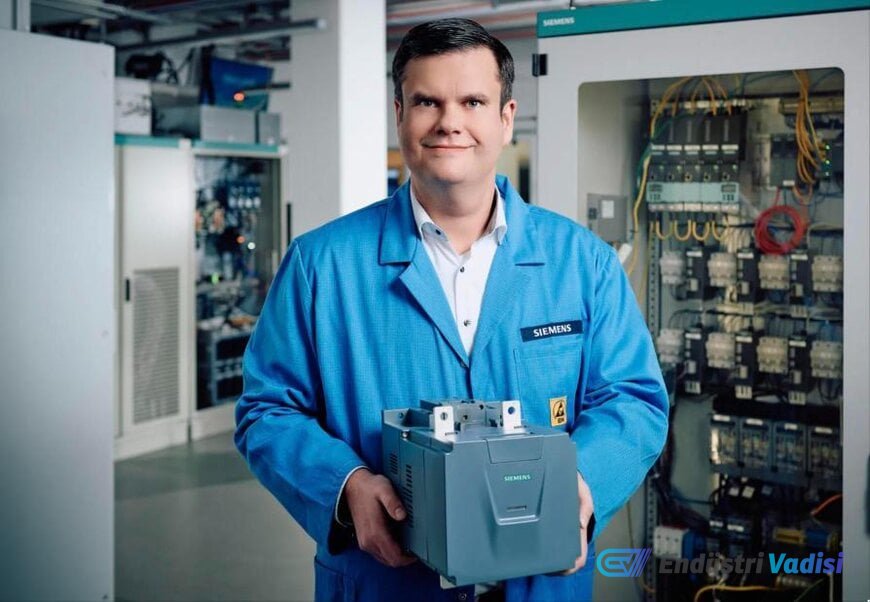
Switching high-voltage direct current (DC) loads in renewable energy and industrial power infrastructures without electrical arcing or rapid contact wear remains one of the biggest challenges in engineering. To address this problem, Siemens has introduced its SIRIUS 3QC1, a semiconductor-based, heavy-duty DC contactor.
🔋 Why a Hybrid DC Contactor?
Industrial facilities and energy operators are increasingly evaluating DC distribution networks to reduce energy conversion losses. By minimizing AC-DC conversions and directly integrating photovoltaic arrays with battery storage, DC architectures can achieve up to 8% energy savings. Furthermore, higher voltage DC distribution can reduce required cable cross-sections, leading to material savings of up to 50%.
However, safely interrupting high DC currents up to 1,500 V places severe thermal and mechanical stress on conventional switching hardware. Without reliable arc suppression and physical isolation, facility operators frequently encounter component wear, high maintenance costs, and reduced system availability.
⚙️ Hybrid Semiconductor and Mechanical Operating Principle
The SIRIUS 3QC1 overcomes these switching limitations through a hybrid architecture that combines power semiconductors with mechanical contacts. During switching transitions, the semiconductor elements precisely interrupt the current without mechanical wear, preventing the formation of electrical arcs. For continuous operation, when the circuit is closed, mechanical contacts carry the current to ensure low-loss conduction.
When the circuit needs to be isolated, the mechanical contacts open, providing physical galvanic isolation and ensuring a reliable interruption of the conductive path. Since the mechanical contacts are not exposed to arc wear during load switching, the device offers a mechanical and electrical life of at least 150,000 switching cycles.
🔄 Bidirectional Control: Ideal for Energy Storage, E-Mobility, and Marine Systems
A defining engineering feature of the SIRIUS 3QC1 is its bidirectional switching capability, which is the ability to interrupt current regardless of its direction. This functionality is vital for applications characterized by continuous charge and discharge cycles.
- Battery Energy Storage Systems (BESS): Suitable for use in standard 100 kW power racks and high-power racks up to 375 kW (300 A at 1,500 V).
- E-Mobility Infrastructure: Supports megawatt fast-charging stations up to 1,000 kW for commercial fleets, electric trucks, and buses.
- Marine Power Systems and Industrial DC Microgrids: Ideal for combining photovoltaic generation with energy storage to maintain operation during AC grid failures.
📊 Technical Specifications and Facility Integration
The SIRIUS 3QC1 utilizes a compact, familiar architectural layout to simplify cabinet engineering and reduce initial investment costs. Wear-free semiconductor switching reduces operating costs by eliminating routine contact maintenance. The contactor also supports remote switching, removing the need for manual on-site intervention during routine grid reconfiguration or fault management.
The SIRIUS 3QC1 portfolio covers rated operating voltages up to 1,500 V DC and is available in four rated current values: 300 A, 400 A, 500 A, and 600 A. Control is provided via a 24 V DC control voltage. Designed for demanding industrial and outdoor cabinet environments, the unit can operate in ambient temperatures ranging from -25 °C to +60 °C and at relative humidity levels up to 95%. An integrated display equipped with status and condition LEDs provides direct visual diagnostics on the panel.
💡 Why is DC Switching Challenging?
Interrupting a 1,500 V DC circuit is a fundamentally different physical challenge than switching an alternating current (AC) load. AC waveforms naturally pass through zero current 100 or 120 times per second in 50 Hz and 60 Hz grids, which helps extinguish the plasma arc between separating contacts. Direct current has no natural zero-crossing point, meaning that purely electromechanical DC contactors must stretch, cool, and extinguish a continuous high-energy arc using large arc chutes, magnetic blow-out coils, or hermetically sealed gas-filled chambers.
In contrast, purely solid-state DC switches eliminate arc formation and mechanical wear but generate continuous on-state conduction losses in their semiconductor junctions, producing significant waste heat that requires large heat sinks or active thermal management. Pure semiconductor switches also lack a physical air gap and therefore cannot independently meet galvanic isolation requirements under international low-voltage switching equipment standards such as IEC 60947-4-1. Hybrid DC contactors bridge this engineering gap by routing steady-state current through low-resistance metallic contacts while briefly commutating current through parallel semiconductors during opening and closing transitions.