








Semih Asil
Industry Valley
- Thread Author
- #1
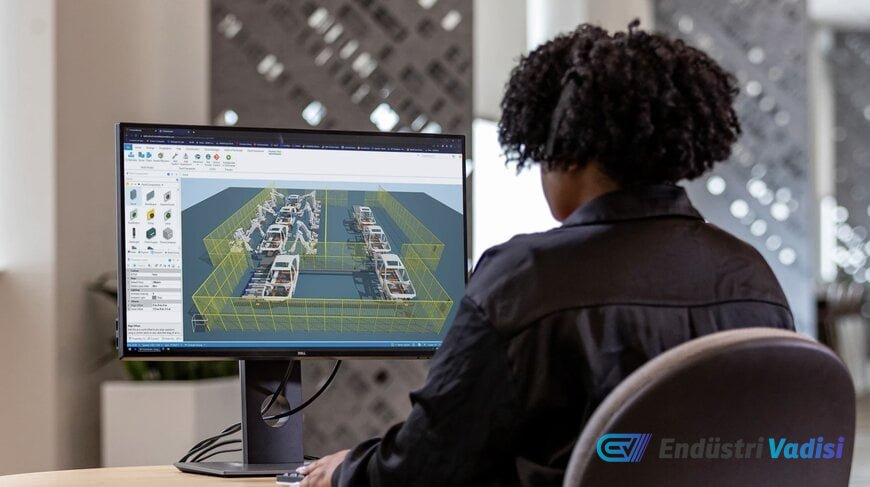
A New Era in Factory Simulation
Rockwell Automation has taken a significant step in factory-scale virtual commissioning and AI-powered manufacturing design by integrating NVIDIA Omniverse, RTX, and OpenUSD technologies into its Emulate3D software. This integration aims to reduce the complexities faced by industrial automation teams designing modern manufacturing facilities.
Overcoming the Limits of Traditional Simulation
Traditional simulation environments often struggle with rendering accuracy, large-scale system bottlenecks, and fragmented file formats when modeling connected multi-line production facilities. Without physically accurate, full-scale virtual environments, engineers risk discovering kinematic collisions, control logic errors, and throughput constraints only during physical setup. This leads to costly commissioning delays. To overcome these engineering hurdles, it is necessary to integrate deterministic control testing software with photorealistic rendering, open scene description standards, and physics-based digital twin architectures before hardware deployment.
Factory-Scale Virtual Commissioning and OpenUSD Integration
To expand the scale and visual fidelity of industrial simulation, Rockwell Automation announced the integration of NVIDIA Omniverse, NVIDIA RTX rendering, and Universal Scene Description (OpenUSD) technologies into its Emulate3D digital twin software. This combined architecture merges Emulate3D's built-in control testing and discrete event simulation engines with NVIDIA's spatial computing and real-time ray tracing frameworks.
This integration enables manufacturing engineers to model, test, and optimize entire factory environments earlier in the engineering lifecycle. By validating PLC code, material handling flows, and multi-robot kinematics in a physically accurate virtual environment, engineering teams can identify design flaws and mitigate commissioning risks before physical equipment arrives at the facility. According to Matheus Bulho, Senior Vice President of Software and Control at Rockwell Automation, combining Emulate3D with Omniverse and OpenUSD creates a deterministic foundation for AI systems to learn, validate decisions, and optimize operational performance before deployment.
Accelerating Engineering Decisions and AI-Powered Workflows
The updated Emulate3D environment supports complex, plant-wide digital twins that can generate deterministic simulation results to train and validate industrial AI models, going beyond individual machine cells. Lora Green, Senior Manager of Advanced Manufacturing Simulation at GE Appliances, stated that the advancement of industrial simulation provides manufacturing teams with the flexibility to evaluate new concepts earlier, make data-driven engineering decisions, and approach physical deployment with higher confidence.
By creating a unified, OpenUSD-compliant virtual environment, manufacturers can facilitate collaboration across mechanical, electrical, and control engineering disciplines, while also building the necessary digital infrastructure for AI-powered factory workflows.
Technical Details and Competitive Advantages
In industrial digital twin and virtual commissioning workflows, Emulate3D performs hardware-in-the-loop (HIL) and software-in-the-loop (SIL) tests by directly connecting to physical or emulated programmable logic controllers (such as Rockwell's Studio 5000 Logix Emulate and FactoryTalk Logix Echo). In the past, dynamic simulation platforms relied on proprietary mesh formats and rasterized graphics pipelines that required aggressive polygon reduction when scaling from a single packaging cell to a 500,000-square-foot assembly facility. Integrating OpenUSD and NVIDIA RTX rendering through Omniverse libraries allows Emulate3D to publish large, multi-CAD assemblies with physically based materials (MaterialX) and real-time ray tracing without sacrificing deterministic physics step rates, while providing synthetic data generation pipelines to train vision-assisted robotics and reinforcement learning agents.
In the industrial simulation and virtual commissioning software market, Rockwell Automation's Emulate3D directly competes with Siemens Tecnomatix Process Simulate and Plant Simulation, Dassault Systèmes DELMIA, Visual Components, and ABB RobotStudio. While Siemens is aggressively integrating Omniverse into its Teamcenter and Xcelerator portfolios and Visual Components has introduced its Omniverse-powered FactoryLens viewing window, Rockwell differentiates Emulate3D through deep, native catalog integration with Allen-Bradley ControlLogix and CompactLogix controllers, Kinetix motion drives, and iTRAK independent cart technology. By embedding Omniverse and OpenUSD directly into this control-centric workflow, Rockwell enables its installed base of control engineers to transition from traditional PLC ladder logic validation to full-scale, AI-ready factory digital twins without moving away from the Studio 5000 ecosystem.




















