




Elif Özaksu
Corporate
- Thread Author
- #1
Overcoming Manufacturing Bottlenecks
High-mix, low-volume metal fabrication operations encounter severe engineering bottlenecks when adapting robotic arc welding cells due to frequent product variants and engineering design changes. Traditional online programming requires taking active welding cells offline and manually jogging manipulators along each weld path. This halts physical production and ties up expert welding engineers.
Even conventional offline programming tools often require tedious manual edge selection in CAD models, separate software workflows for different robot brands, and complex manual kinematic adjustments to avoid joint limits or torch collisions. Resolving these setup bottlenecks requires specialized offline programming software that can extract weld joints directly from 3D geometry, automatically solve multi-axis reachability, and generate controller-ready code for heterogeneous robot fleets while physical cells remain operational.
A New Era with Visual Components Arc OLP
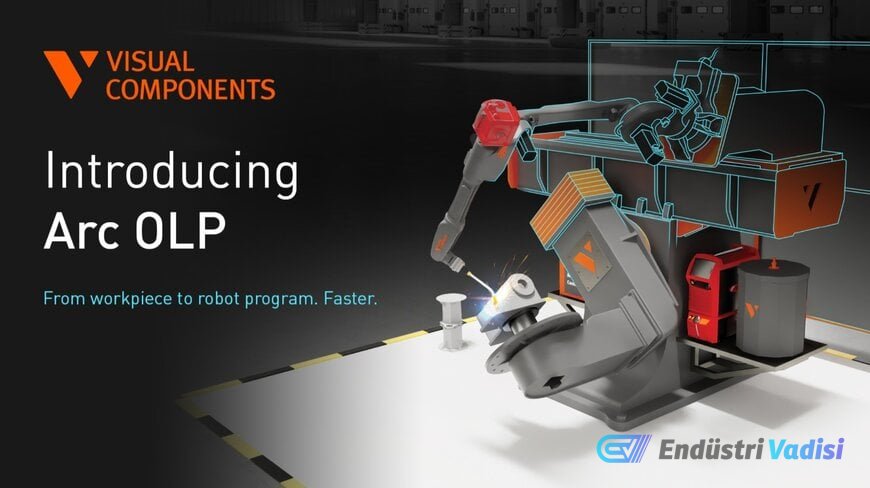
To compress preparation cycles between CAD release and shop floor deployment, Visual Components has introduced Arc OLP, a dedicated offline robot programming solution, with Visual Components 5.2. Designed for manufacturers, system integrators, and robot OEMs, this software unifies weld identification, trajectory validation, and post-processing into a single digital workflow.
Geometry-Driven Weld Detection and Automated Path Solving
The operational process begins with Auto Weld, an algorithmic feature that automatically detects suitable weld seams by analyzing imported 3D part geometry. Rather than blindly flagging every geometric edge in an assembly, Auto Weld applies built-in welding logic to isolate realistic joint opportunities. Welding specialists visually inspect proposed seams on the 3D workpiece, filter selections based on formal welding procedure specifications and quality standards, refine torch angles, and determine weld sequencing to manage thermal distortion before commencing code generation.
Once seam sequences are finalized, Guided Workflow automates trajectory generation and post-processing. An integrated kinematic solver evaluates the modeled work cell (including robot manipulator, weld torch geometry, workpiece, and clamping fixtures) to automatically resolve reachability constraints, wrist configurations, and axis joint limits. After engineers validate simulated motion paths in the virtual environment, built-in post-processors convert trajectories into native controller code tailored to the target robot brand, leaving only standard physical cell calibration and final dry-run validation before production.
Decoupled Cell Preparation and Multi-Brand Fleet Standardization
Arc OLP decouples programming labor from active machine utilization. This allows engineering teams to create, validate, and modify robot routines offline while physical welding cells continue to run live production batches. When engineering change orders modify part geometries, specialists update affected seams, regenerate kinematic paths, and virtually validate collision clearances before deploying revised code to the shop floor.
The platform operates under a predictable licensing model without per-weld quotas or escalating usage fees, and supports optional on-premise deployment to comply with corporate IT security policies. Furthermore, by supporting a single standardized programming workflow across multiple industrial robot brands, Arc OLP enables multi-vendor fabrication facilities and small-to-medium enterprises to consolidate operator training and programming standards rather than maintaining separate, brand-specific offline tools.