








Semih Asil
Industry Valley
- Thread Author
- #1
Introduction
Universal Robots and Mobile Industrial Robots have introduced integrated hardware and software solutions aimed at advancing intelligent automation within industrial supply chains. These innovations specifically target end-of-line production and warehouse logistics processes.
🤖 AI-Powered Pallet Transportation
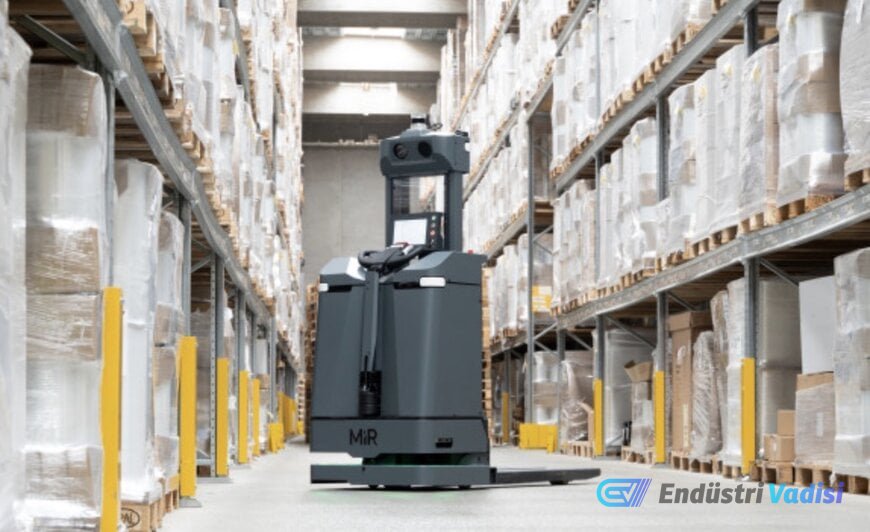
The companies showcased their latest autonomous mobile robot (AMR) capabilities. The MiR1200 Pallet Jack enables the automatic detection, transportation, and delivery of pallets and containers weighing up to 1,200 kilograms. Designed for heavy logistics and material handling, this system dynamically identifies loads through its AI-based pallet detection framework, reducing cycle times in picking and placement operations.
- Safety: Compliant with the ISO 3691-4 safety standard, it can safely navigate alongside people and obstacles in narrow industrial environments.
- Speed and Uptime: Operates at a maximum speed of 1.5 meters/second and features a fast-charging battery system that provides eight hours of continuous operation.
- Integration: Easily integrates into existing facility layouts without the need for external guides, offering an automated alternative to manual pallet trucks.
🤝 Unified Architectures for Collaborative Robotic Systems
Universal Robots detailed its Gen 7 platform to meet the growing need for an industrial automation ecosystem. This seventh-generation collaborative robotics framework unifies the new g-Series cobots with the CB7 controller, TP7 and SP7 programming interfaces, and the PolyScope X software environment. This unified architecture improves network connectivity and simplifies the integration of third-party peripherals and machine vision systems.
The companies demonstrated how these unified technologies operate in hybrid setups. Mobile robots managed the continuous transportation of pallets and carts, while stationary cobots performed box erection, packing, and palletizing routines. Additionally, a Mobile Cobot configuration was showcased, combining autonomous AMR navigation with multi-axis robotic arm manipulation, enabling flexible, decentralized end-of-line distribution.
🔍 Technical Details and Competitive Analysis
The MiR1200 competes with systems such as the Agilox OCF and Seegrid Palion in the autonomous pallet jack and AMR market. Competitive comparisons typically focus on carrying capacity, maximum speed, and navigation modes. While traditional automated guided vehicles (AGVs) rely on magnetic tape or QR codes, heavy-duty AMRs use 3D cameras and LiDAR with SLAM (Simultaneous Localization and Mapping) for infrastructure-free navigation.
The MiR system's 1,200 kg capacity and 1.5 m/s speed align with industry standards for heavy-load automated forklifts. However, its key technical differentiator is the explicit integration of AI-powered pallet detection. This allows for dynamic interaction with misaligned, damaged, or non-standard pallets – a critical metric where modern AMRs diverge from previous generation automated systems that required strict positional precision for load interaction. Similarly, UR's Gen 7 platform competes with collaborative ecosystems from KUKA and Yaskawa, heavily comparing on the native integration of AI protocols and the modularity of the controller architecture.





















