








Süeda Asil
Corporate
- Thread Author
- #1
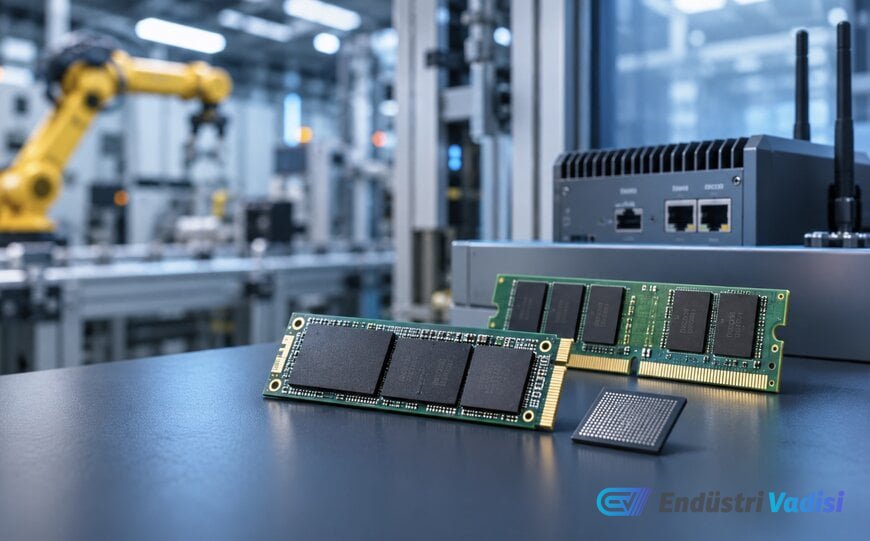
Comprehensive Portfolio for Robust IoT Environments from Kingston Technology
Kingston Technology is showcasing its solutions designed for demanding IoT environments by presenting its extensive portfolio of industrial storage and DRAM modules. These products have been specifically developed to meet the high integration and reliability requirements of industrial automation, Internet of Things (IoT), and edge computing applications.
Component Architectures for Embedded Systems
Kingston's portfolio includes various embedded technologies such as industrial DRAM, solid-state drives (SSDs), eMMC, UFS, and eMCP modules. This diversity offers scalable options for different system architectures and space constraints. For example, compact eMCP modules are ideal for edge computing devices operating in industrial IoT nodes with limited space, while high-performance automation controllers rely on UFS for fast data access and continuous sensor logging. System designers can balance power consumption, thermal output, and bandwidth by selecting the appropriate memory interface.
Lifecycle Management and Supply Continuity
In the long deployment cycles typical of industrial manufacturing, component availability remains a critical engineering constraint. To mitigate integration risks, Kingston employs a controlled Bill of Materials (BOM) methodology and strict lifecycle management practices. This approach stabilizes the internal components of memory modules, ensuring firmware and hardware consistency across production runs. This allows designers to transition directly from prototype validation to long-term production without the need for frequent re-qualification testing.
Technical Specifications of Industrial Memory Components
In the industrial embedded storage sector, components are often compared with similar products from manufacturers like Transcend and Micron. Standard evaluation criteria for these environments include operating temperature thresholds, endurance ratings, and interface throughput. Typical industrial-grade embedded MultiMediaCard (eMMC) and Universal Flash Storage (UFS) components must have a wide operating temperature range of -40°C to +85°C to withstand harsh manufacturing conditions. This differs from standard commercial drives, which are typically limited to -25°C to +85°C.
Compared to standard consumer storage, industrial solid-state drives (SSDs) prioritize endurance through Pseudo Single-Level Cell (pSLC) modes or optimized Multi-Level Cell (MLC) configurations. This provides endurance capabilities that can exceed typical consumer benchmarks with high Terabytes Written (TBW) ratings scaled for continuous machine-to-machine data logging. Furthermore, competitive industrial storage implements hardware-level power loss protection and advanced error correction code (ECC) mechanisms to prevent data corruption during sudden power failures. Through these measurable features, industrial memory architectures ensure continuous and reliable functionality for remote edge computing and automation networks.





















