






Alper Aktaş
Endüstri Vadisi
- Thread Author
- #1
Innovative Solutions for Positioning Problems in Industrial Robotics
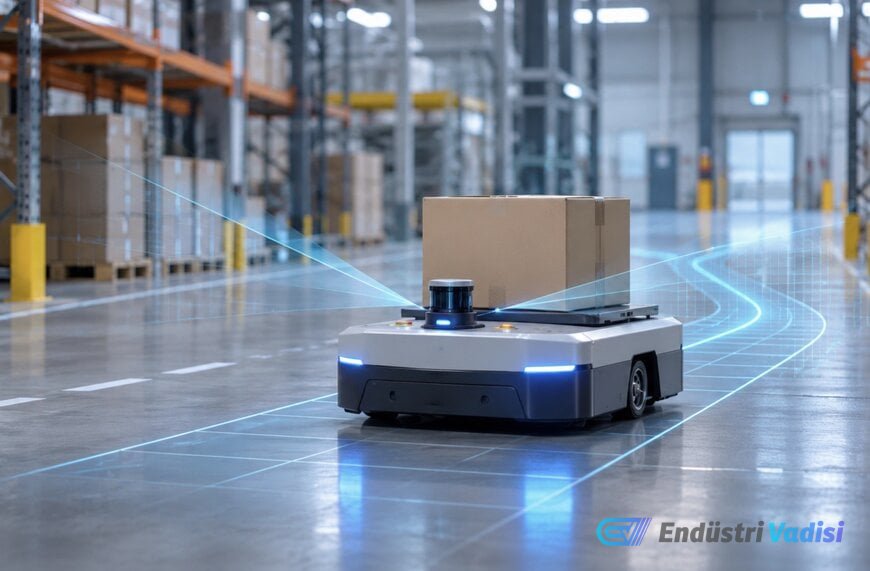
A new extension developed in collaboration between Analog Devices (ADI) and NVIDIA enables industrial robots to perform reliable real-time positioning in complex environments. This extension combines wheel encoders, inertial measurement units (IMUs), and adaptive sensing capabilities, marking a significant step forward for differential drive and transport robots.
Reducing Positional Drift in Repetitive Environments
Traditional Simultaneous Localization and Mapping (SLAM) systems struggled in industrial facilities with monotonous walls, repetitive shelving, and varying lighting. Although Visual SLAM (VSLAM) used cameras, rapid turns or line-of-sight obstructions often led to positional drift. To solve these problems, engineers turned to a tightly coupled estimation unit that could process complementary sensor data on edge computing platforms, rather than relying on single measurement sources.
Direct Integration of Wheel Odometry
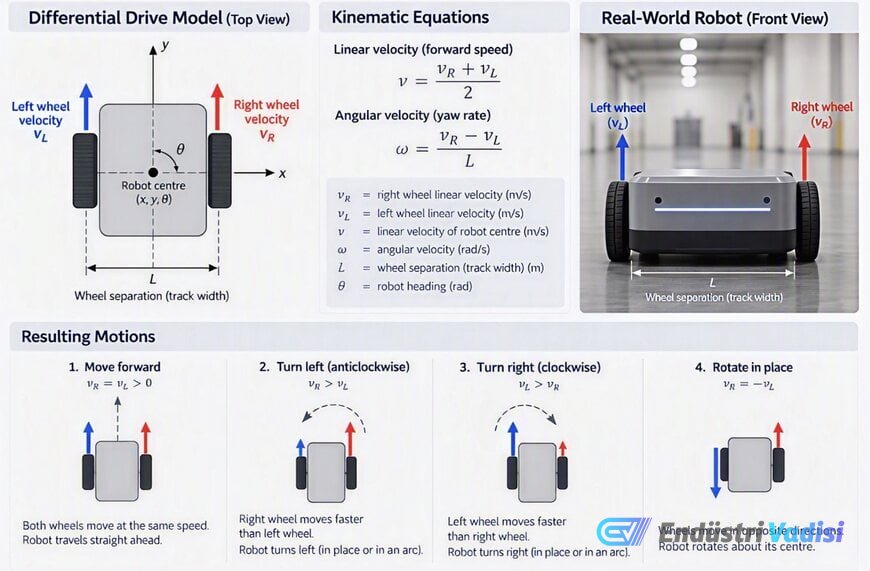
This new architecture directly incorporates measurement data from wheel encoders into the positioning process. By simultaneously evaluating visual and mechanical data, a 60% reduction in average position estimation error was achieved. In complex robot trajectories, the integration of mechanical wheel telemetry with spatial visual data reduced the average positional deviation from 24.2 centimeters to 9.7 centimeters. In embedded hardware, the maximum tracking error decreased from 1.923 meters to 0.275 meters, with processing time increasing only from 1.40 to 1.81 milliseconds. This redundancy maintains tracking during camera obstructions, limiting error to 13.2 centimeters during a five-second visual blackout, while cross-referencing with camera data during wheel slippage reduces deviation to 28.7 centimeters.
Geometric Tracking in Low-Texture Environments
Visual algorithms often require distinct textures and corners, but these are rare on flat surfaces like factory floors. The extended library enables continuous tracking of linear geometric elements such as door frames, structural edges, and continuous shelving. By identifying these lines from multiple viewpoints and dynamically balancing them with traditional point tracking, the system maintains trajectory lock even in the absence of standard textures. This dual point and line tracking method provided measurable improvements in positional accuracy in 26 out of 30 different indoor test profiles.
Adaptive Sensor Weighting with Smart Fusion
Instead of using a static calibration factor between optical sensors and IMUs, the system introduces an adaptive weighting architecture called Smart Fusion. A lightweight machine learning model, requiring only 914 adjustable parameters, evaluates 10 real-time metrics, including feature visibility duration and camera tracking error, to switch between "vision-trusted" and "IMU-trusted" operating states. When visual features degrade, the system automatically gives more weight to IMU data. This dynamic approach reduced the average position error by 27.7% (from 20.2 to 14.6 centimeters) in the EuRoC micro aerial vehicle dataset and improved accuracy by 14.9% (from 27.0 to 23.0 centimeters) in the TUM-VI indoor sequences.
ADI's Differentiation in a Competitive Environment
Standard open-source frameworks like ORB-SLAM3 typically rely on point-based feature extraction and vision-IMU fusion, achieving high accuracy in well-textured environments. However, traditional VSLAM systems can experience severe degradation or tracking failure in visually ambiguous industrial environments because they lack local, tightly coupled integration of wheel kinematics and linear geometric features. ADI's extension differentiates itself by synchronizing continuous wheel odometry, linear structural tracking, and adaptive IMU weighting in a unified GPU-accelerated pipeline, mitigating cumulative drift and wheel slippage vulnerabilities that compromise standard loosely coupled navigation stacks.