








Hasan S. Cemkan
Corporate
- Thread Author
- #1
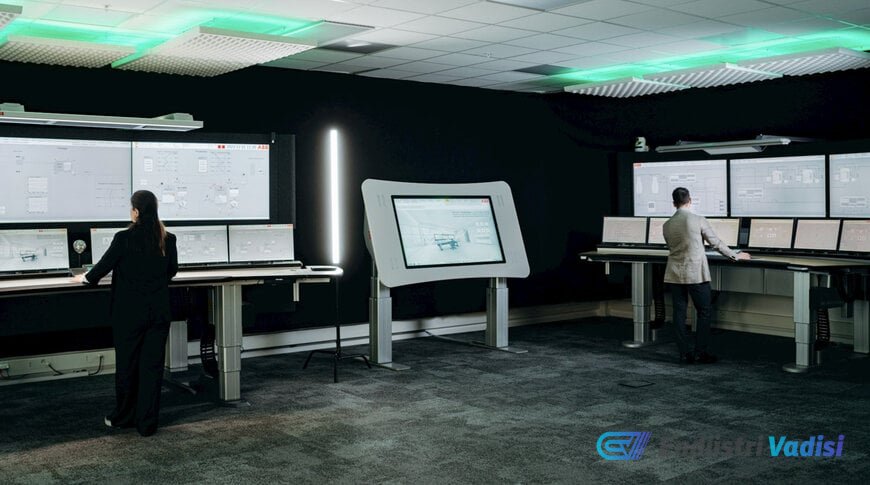
A New Era in Control Rooms: AI-Powered Decision Support
ABB has launched the ABB Ability Augmented Operator software suite to address personnel shortages in control rooms and support real-time decision-making processes. The knowledge gap created by the retirement of experienced engineers and the increasingly complex challenges of plant management necessitate such innovative solutions.
Operational Challenges and Demographic Shifts
Continuous process plants, such as those in chemical, hydrocarbon processing, thermal power generation, and municipal water treatment, require 24/7 oversight. When unexpected process deviations occur, operators must analyze thousands of simultaneous telemetry signals, process variables, and alarm conditions. An incorrect adjustment or delayed intervention can lead to product quality degradation, thermal excursions, flaring events, or unplanned emergency shutdowns.
According to International Energy Agency data, in advanced economies, there are 2.4 energy sector workers for every new energy sector worker under 25 approaching retirement age. This demographic imbalance, coupled with plants being managed from centralized remote operations centers, results in smaller teams overseeing broader operational areas. This situation increases reliance on empirical plant knowledge that is lost with the retirement of experienced personnel.
Integrated Anomaly Detection and Predictive Simulation
ABB Ability Augmented Operator integrates directly into distributed control system operator workstations, functioning as a real-time advisory layer rather than an opaque autonomous controller. The software architecture simultaneously monitors multivariate process data streams, identifying low-amplitude deviations and inter-variable correlations before traditional high-low threshold alarms.
The system workflow consists of three core engineering mechanisms operating within a unified graphical interface:
- Multivariate Anomaly Identification: Machine learning algorithms analyze live sensor data against baseline operational models, isolating subtle operational deviations before hard process limits or safety instrumented triggers are engaged.
- Historical Context Retrieval: Upon detecting an anomaly, the engine queries the plant's historical process archive, indexing previous events exhibiting similar multivariate signatures. The software displays the root causes identified in these past events and the specific corrective actions taken by previous engineering shifts.
- Predictive "What If?" Simulation: Before making manual adjustments to control loops, operators can run localized predictive simulations. The software projects critical process variable trajectories across forward-looking time horizons, demonstrating the likely consequences of a planned change and verifying that safety envelopes will not be violated.
Throughout this process, the software provides explainable recommendations based on empirical operational records, ensuring that the ultimate authority for execution remains squarely with the human operator.
Gino Hernandez, Global Digital Business Unit Head for ABB Energy Industries, stated, "AI will play an increasingly important role in the control rooms of industrial plants, but it has to earn its place. Operators need to understand and trust the tools they rely on, which is why how AI is introduced is as important as what it can do. ABB designed Augmented Operator to explain its reasoning, leverage the plant's own experience, and allow operators to test a change before they make it. This offering is a significant step towards more autonomous operations while keeping humans in the loop."
Operational Impact and Industry Position
In continuous processing units, early anomaly mitigation stabilizes operating envelopes, narrows shift-to-shift performance variance, and reduces off-spec production volume. By transforming corporate operating experience into an accessible advisory system, industrial operators standardize response protocols across multi-plant portfolios and accelerate the onboarding of early-career control room engineers.
Industrial control room advisory systems operate at Levels 3 and 4 of the ISA-95 enterprise control integration model, bridging real-time Distributed Control Systems (DCS) with manufacturing operations management software. Historically, alarm and situational awareness management relied on static engineering guidelines governed by standards such as ANSI/ISA-18.2 and EEMUA Publication 191. While effective in rationalizing nuisance alarms, these systems are fundamentally reactive, only triggering notifications when a measured variable exceeds a pre-configured threshold.
ABB Ability Augmented Operator differentiates its workflow architecture by combining multivariate anomaly detection with automated historical log pattern matching and integrated operator-in-the-loop dynamic simulation. Rather than replacing existing Level 2 regulatory control loops or advanced process control matrices, the software functions as a layer over systems like ABB System 800xA and third-party control architectures. By leveraging industrial data connectivity via standard OPC UA interfaces and time-series historians, it translates multi-year process telemetry into explainable, non-intrusive operator guidance without requiring direct write access to safety instrumented systems governed by IEC 61511.





















