








Cengiz Özemli
Academic
- Thread Author
- #1
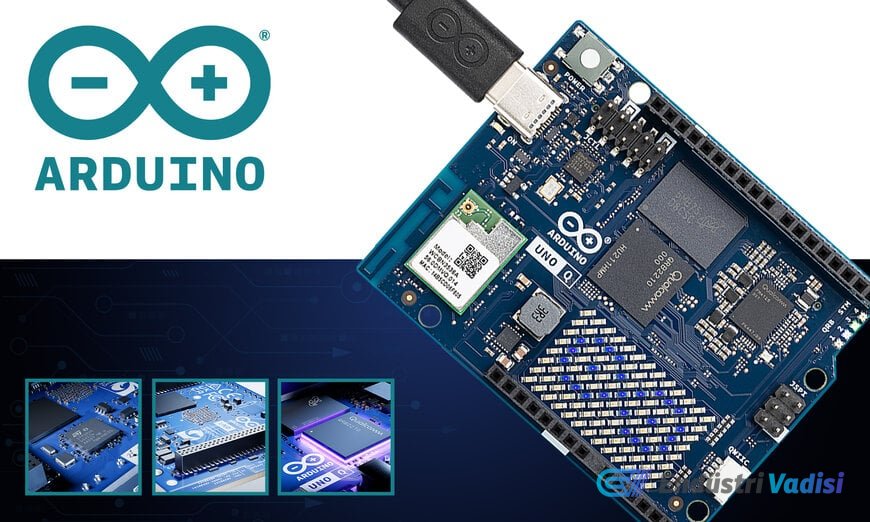
A New Era in Industrial Automation
TME (Transfer Multisort Elektronik) will showcase the capabilities of the Arduino UNO Q at the electronica 2026 exhibition. This compact embedded platform democratizes automation by processing image data locally, removing traditional financial and technical barriers to Edge AI vision inspection on production lines.
Cost-Effective Quality Control
Traditionally, automated vision inspection systems relied on expensive smart cameras and complex architectures. With the Arduino UNO Q, engineers can rapidly build a proof-of-concept (PoC) to test machine learning models in-house. Once trained on sample images, these models can classify products, detect assembly errors, and identify surface defects in real-time.
By keeping image processing at the "edge," the system significantly reduces network load, minimizes latency, and ensures immediate responses to irregularities in production.
Seamless Factory Integration
A typical vision inspection station powered by the Arduino UNO Q integrates a compatible camera, LED illumination, and part presence sensors. With native Bluetooth and Wi-Fi connectivity, the board seamlessly transmits localized classification results to operators or directly to industrial PLC, SCADA, and MES networks. Available from TME in 2GB and 4GB variants, this versatile platform can scale beyond optical inspection to encompass predictive maintenance tasks (including condition monitoring and vibration analysis).
TinyML and Neural Network Quantization at the Edge
Running complex neural networks, such as Convolutional Neural Networks (CNNs) used for image classification, on compact embedded platforms requires a specialized engineering paradigm known as TinyML. Since microcontroller-class devices lack the massive parallel processing cores and extensive memory of data center GPUs, AI models must be aggressively optimized before deployment. This is primarily achieved through a mathematical process called "quantization." This process reduces the precision of the network's weights and activations (typically converting from 32-bit floating-point numbers to 8-bit integers) without significantly degrading the model's prediction accuracy. This compression reduces the memory footprint and computational requirements, allowing platforms like the Arduino UNO Q to store the model directly in RAM and execute inference locally. Consequently, the edge device transmits only lightweight metadata (e.g., an alert flag for a defective part), rather than streaming raw video feeds. This secures proprietary production data and guarantees deterministic, microsecond-level response times immune to network bandwidth fluctuations.





















