








Elif Özaksu
Corporate
- Thread Author
- #1

Time Counter That Starts When a Machine Stops
When a machine stops, the facility's systems begin to record the time. The Manufacturing Execution System (MES) records the downtime until the machine restarts, while the Computerized Maintenance Management System (CMMS) opens a work order. Technicians log their hours to this work order. However, none of these records alone indicate how much of a technician's shift was spent on repair.
What is "Wrench Time"?
According to Doc Palmer's definition, "wrench time" is the portion of a technician's available working hours dedicated to productive work. The remaining time is lost to delays such as waiting for parts, tools, instructions, permits, or assignments, traveling, and coordinating with other teams. Paperwork, including entering time and feedback into the CMMS, is considered direct work. So, this term encompasses more than just time spent with a tool in hand.
Average and Target Figures
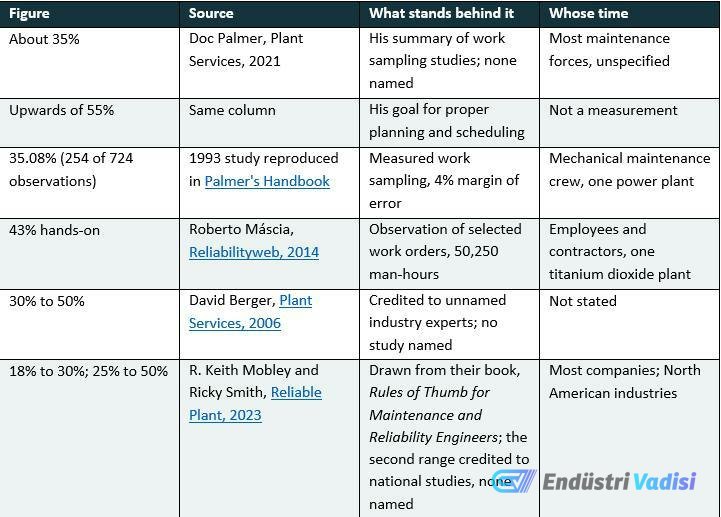
According to Palmer, wrench time in most maintenance teams is around 35%. With proper planning and scheduling, the goal is to increase this rate to over 55%. However, these figures are often based on data from a single facility and have limited generalizability.
Limitations of Data and Important Warnings
The factors affecting wrench time are more important than a single figure. Prior planning shortens in-job waits, while scheduling reduces dead time between one job and another. However, Palmer warns that wrench time can be "terrible" as a tracking metric because it says nothing about how efficiently the work is done or whether the work is worth doing. A facility can learn more by measuring its own data twice in the same way than from general statistics.
What Do Facility Records Show and Miss?
- Downtime: Standards define downtime around the machine. However, these definitions do not separate the waiting times surrounding the repair. Researchers at the National Institute of Standards and Technology (NIST) warn that the entire period from machine stoppage to restart may not be dedicated to repair.
- Work Orders: Work orders may include timestamps such as technician arrival at the machine, parts ordered, parts delivered, problem resolved, and machine running. However, not every manufacturer records these elements. Technicians often record work informally or not at all.
- Completion Dates: Completion dates can also create distortions. In a NIST case study, approximately 93% of HVAC work orders were closed on a Friday. This suggests that completion dates do not match the time the work was finished on site.
- Logged Hours: The IEC dictionary states that maintenance man-hours are "a measure of resource utilization, which may be estimated or actual, and is not the actual duration of the maintenance action." Logged hours may not reflect the actual work performed on the equipment.
What Should Change Next Week?
Four changes can be made to existing records to better show where the team's time is going:
- Timestamp technician arrival and parts: In addition to machine downtime and operation, record when the technician arrived at the machine, and when parts were ordered and received. This separates dispatch time and parts waiting time.
- Check completion dates before trusting any duration: If most completions fall on the same weekday, these dates most likely reflect management routine, not the time spent on the job.
- Read schedule compliance with reasons: According to Palmer's method, count how many of the initially planned work orders the team completed. This shows why all planned work could not be done. Record a delay reason for each delayed job and leave space for a short list of reasons and a note.
- Verify logged hours: As SMRP does, measure planning and supervision skill by comparing actual hours to the planning estimate. Wrench time can be used as a trend to indicate whether unnecessary delays are being eliminated.
In summary, facility records alone do not fully reflect the technician's true "wrench time." However, with the right approaches, this data can be made more meaningful and provide valuable insights for improving maintenance processes.