







Semih Asil
Industry Valley
- Thread Author
- #1
🚀 Groundbreaking Collaboration Between NEURA Robotics and Technical University of Munich
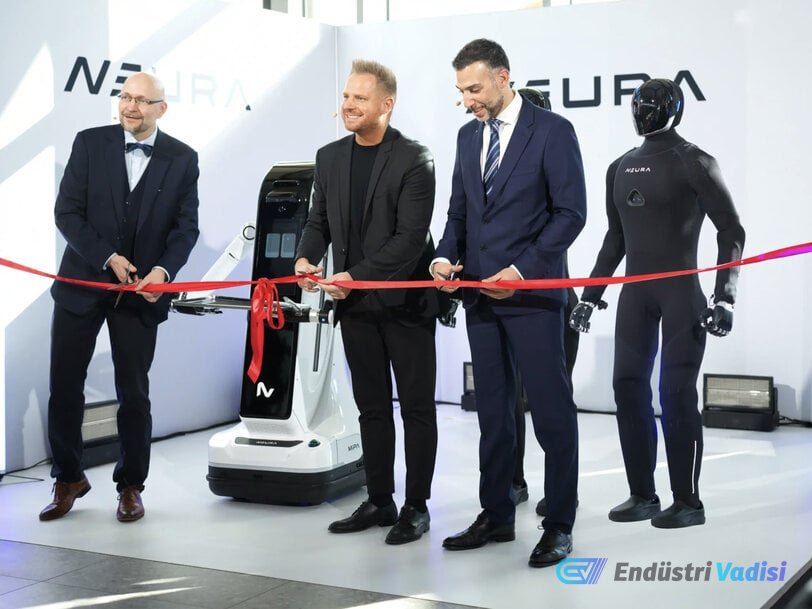
NEURA Robotics and the Technical University of Munich (TUM) have established TUM RoboGym to advance industrial automation capabilities. Located at LabCampus near Munich Airport, this facility utilizes the 4NE1 Gen 4 humanoid robot and cognitive manipulators to transfer physical process expertise into scalable machine learning architectures for the manufacturing, automotive, logistics, and medical technology sectors.
⚙️ AI Solution for Industrial Challenges
Traditional automation systems require rigid programming for every operational change, increasing integration costs in high-mix production environments. To overcome this limitation, NEURA Robotics has initiated a three-year, 17-million-euro joint development venture with TUM's Institute for Robotics and Machine Intelligence. NEURA Robotics is investing 11 million euros in robotic hardware and infrastructure, while the university provides research facilities and engineering personnel.
🧠 Physical AI Architecture and Data Collection
The test site employs a multimodal training architecture to train the proprietary Neuron AI perception-language-action foundation model. Sensor systems record physical force feedback, tactile interactions, kinematics, acoustics, and image data across three operational streams:
- Direct Robotic Application: Captures real-time actuator responses and contact telemetry during production cycles.
- Human Demonstrations: Converts manual craft techniques into numerical kinematic datasets using sensorized motion capture suits and teleoperation rigs.
- Digital Simulation Layer: Applies data augmentation techniques to subject these motion profiles to parametric variations and validates them on physical machines.
Trained models, connected via the Neuraverse network, are propagated among participating robotic nodes.
🦾 Hardware Specifications and Operational Tests
The 4NE1 Gen 4 humanoid platform serves as the primary testbed for mass production integration. Offering a 20% structural mass reduction over the previous model, this unit features a textile outer skin and localized intelligent limbs with embedded reflex circuits for decentralized actuator response. Mechanical hands perform the multi-axis tactile grasps required for handling rigid and semi-flexible components.
Operations at the 2,300-square-meter facility focus on multi-sector trials such as component loading, bottle filling, package handling, and material manipulation. Companies test cognitive robot arms, mobile manipulators like MiPA, and humanoid units against specific line parameters before factory deployment.
📈 Operational Impact
By replacing manual programming routines with physical AI trained on empirical force and sensor data, this architecture shortens commissioning cycles for complex automated tasks. Process stability and gripping precision are enhanced through distributed reflex computation, allowing machines to adapt to positional misalignments in real-time. This facility in Munich serves as a validation blueprint for planned development centers in Europe, North America, and Asia.