








Semih Asil
Industry Valley
- Thread Author
- #1
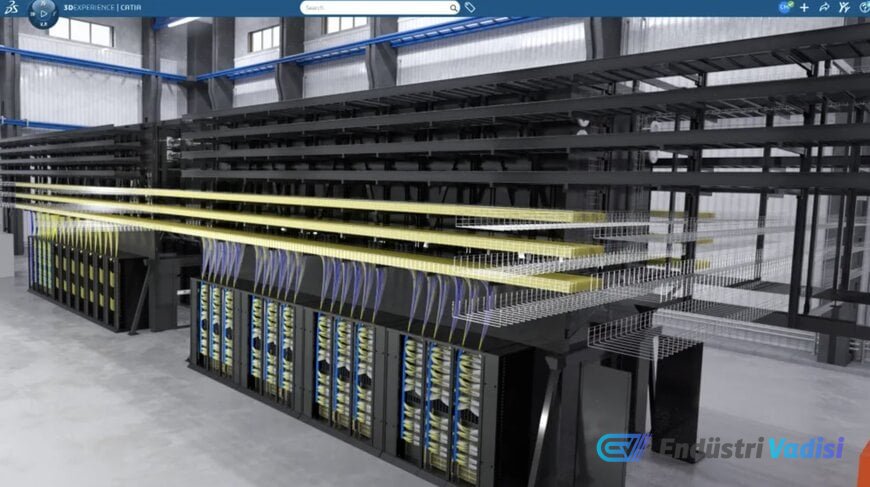
💡 Virtual Twin Technology for AI Factories 💡
Dassault Systèmes and Vertiv have entered into a technical collaboration to configure, simulate, and validate the infrastructure of artificial intelligence (AI) factories before their physical installation. This partnership offers virtual twin and model-based system engineering frameworks for facilities designed around the NVIDIA Vera Rubin DSX AI Factory reference design and the NVIDIA Omniverse DSX Blueprint, specifically targeting high-density computing environments.
⚙️ Operational Complexity and Interdisciplinary Dependencies ⚙️
AI data centers function as structures where thermodynamic and electrical systems are tightly coupled. Unprecedented power densities in server racks mean that thermal dissipation, fluid flow, power distribution, and variations in dynamic computing workloads directly impact adjacent subsystems. Designing mechanical, electrical, and control domains independently leads to significant field integration issues, extended commissioning schedules, and costly late-stage design changes. To overcome these challenges, pre-construction multiphysics modeling is required to validate system performance across dependent domains before groundbreaking.
💻 Technical Architecture and Virtual Twin Integration 💻
The engineering framework combines Vertiv's physical infrastructure designs with Dassault Systèmes' 3DEXPERIENCE platform. Dassault Systèmes provides the core model-based system engineering, computational simulation, and virtual twin environment. Vertiv integrates its pre-engineered SimReady power and cooling reference models with Vertiv OneCore, a hybrid facility architecture that incorporates critical power delivery lines, heat rejection systems, and automated control infrastructure.
Within the 3DEXPERIENCE platform, physical assets are represented as configurable system-level digital models. Engineering teams can evaluate facility layouts, perform interdisciplinary multiphysics simulations, and propagate architectural revisions simultaneously across power, fluid dynamics, and spatial models. Any change in thermal management or electrical busbar distribution automatically maps downstream impacts across the entire infrastructure envelope, preserving design intent from initial configuration to commissioning.
✅ Deployment Validation and Operational Metrics ✅
The integrated modeling environment directly interfaces with standard engineering workflows to generate validated design outputs and commissioning configurations. By shifting engineering validation to the digital design phase, the workflow eliminates physical trial and error during on-site assembly and testing.
Operational modeling benchmarks established by Vertiv indicate that this model-based methodology accelerates initial configuration and validation times by up to 10x compared to traditional workflows. This streamlined transition reduces defined infrastructure deployment times by up to 50%, bringing facility commissioning forward by approximately 10 weeks compared to conventional engineering baselines. In modeled scenarios, earlier facility energization, thanks to accelerated facility readiness, yields up to 30% higher cumulative token output over the first 12-month project cycle for equivalent installed computing capacities.





















