






Cengiz Özemli
Academic
- Thread Author
- #1
Energy Saving and High Performance Combined
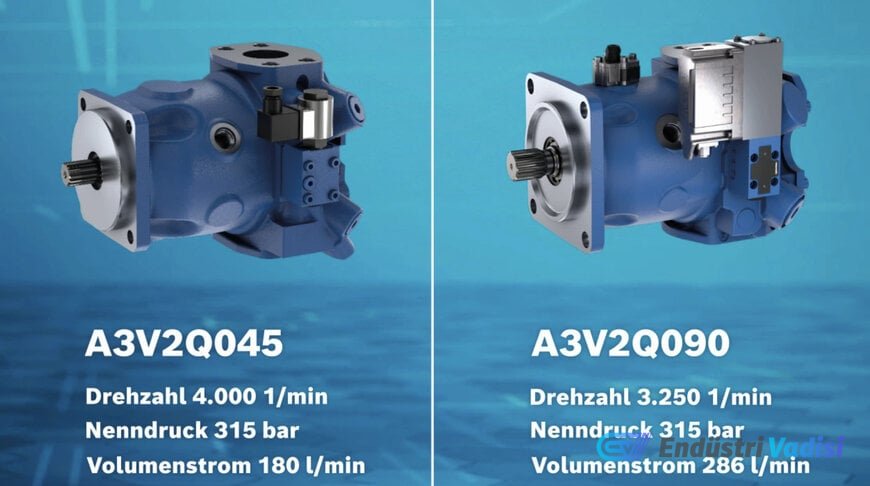
Bosch Rexroth has expanded its industrial hydraulics portfolio by introducing the A3V2Q variable displacement pump, which aims to significantly reduce energy consumption in cyclical applications such as presses and injection molding machines. This new pump offers an ideal solution for applications requiring high volume flows, precise control, and low energy consumption.
A New Era in Efficiency with A3V2Q
Traditional hydraulic systems, especially in cyclical applications, experience high energy losses due to throttling and idling. The A3V2Q, as part of the servomotor-driven A3V pump platform, eliminates this problem by adapting precisely to every operating condition thanks to variable speed adjustment and flexible swivel angles. With a nominal size of 90 cubic centimeters, the A3V2Q delivers volume flows of up to 286 liters per minute, achieving an efficiency of over 91% in its optimum operating range. This represents an increase of up to 5% compared to previous medium-pressure variable displacement pumps and provides up to 70% energy savings in cyclical applications compared to conventional fixed drives.
Faster Processes with Energy Recovery (Recuperation)
A3V series pumps are specifically designed for combined pump and motor operation. When the hydraulic pump is driven backward by the flowing medium (e.g., when lowering a heavy lifting platform or counteracting a die cushion in metal forming), it acts like a motor and drives the connected servomotor as a generator. The electrical current generated by this recuperation can be fed into the machine's intermediate circuit or returned to the electrical grid. This feature actively accelerates the pressure drop after the holding phase in injection molding, thereby shortening the overall cycle time.
Size Reduction in the Electric Drive System
The integration of high-speed concepts makes it possible to produce the same volume flows with 30% less motor torque. The adjustment of the displacement volume according to demand via the pump's control mechanism provides an additional 30% torque reduction in many cyclical processes. This engineering approach enables a significant downsizing of the entire electric drive system. Both the servomotor and the associated frequency inverter can be dimensioned smaller and less powerful. This not only reduces material usage and investment costs but also significantly lowers operational emissions. For a medium-sized industrial press, up to 50 tons of CO2 can be saved in the usage phase due to the increase in efficiency.
A Pioneering Step in Modern Mechanical Engineering
The electrification and increased efficiency of hydraulic systems are central technological drivers in modern mechanical engineering, accelerated by strict global regulatory requirements to reduce the industrial carbon footprint. In the field of injection molding and forming technology, plant manufacturers are increasingly relying on variable-speed pump drives to completely eliminate idling losses. The ability for active energy recovery in 2-quadrant operation is establishing itself as a critical industrial benchmark for reducing the thermal load of the pressurized medium and sustainably lowering the Total Cost of Ownership (TCO) in energy-intensive production environments.