








Semih Asil
Industry Valley
- Thread Author
- #1
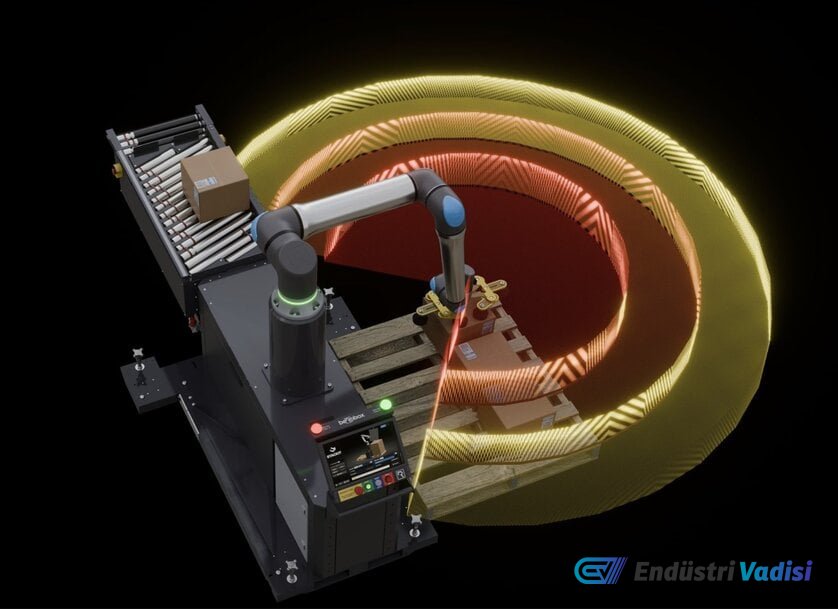
Next-Generation Safety Revolutionizing Human-Robot Collaboration
Collaborative and automated palletizing cells used in high-efficiency packaging lines struggled to balance human-robot safety with operational efficiency. Traditional safety systems relied on static perimeter fences, physical light curtains, or floor-mounted laser scanners. While effective at stopping machine movement in case of a breach, these systems couldn't adapt to the robot's changing positions and frequently caused emergency shutdowns of the entire cell during routine manual pallet changes.
Limitations of Optical Sensors and the Acoustic Solution
Optical safety technologies, such as infrared area scanners and camera systems, could experience performance degradation in challenging industrial environments due to dense dust, varying ambient lighting, high-contrast glare, or reflective packaging materials. To address these limitations, there was a need for dynamic, volumetric presence detection integrated directly into moving robotic kinematic structures.
3D Dynamic Safety Module from beRobox
To modernize material handling safety, beRobox introduced 3D Dynamic Safety, an arm-integrated safety module designed for the PALTZ robotic palletizer portfolio. This module, instead of confining safety zones to static boundaries around the workstation, mounts sensing instruments directly onto the articulated robot arm. As the manipulator moves, the sensor moves with it, creating a volumetric safety zone that dynamically adapts to the robot's real-time trajectory and coordinates.
Seamless Operation with Smart Zone Management
This localized, dynamic awareness allows the palletizer to selectively manage operator interactions without initiating unnecessary full-cell shutdowns. During dual-bay palletizing sequences, an operator can enter an adjacent pallet station to remove finished loads or position empty pallets, while the robot arm can safely continue stacking in the active station. The sensor provides continuous presence detection as it constantly monitors the 3D space around the tool at the moving arm's end. If an operator remains in the robot's active zone, the system prevents unwanted restarts until the envelope is completely clear.
Acoustic Sensing in Challenging Environments
The dynamic module is powered by ADAR One, an ultrasonic sensing and ranging sensor developed by Sonair. Built using an array of piezoelectric micromachined ultrasonic transducers (PMUTs), the unit uses airborne ultrasound instead of optical beams to map the environment in three dimensions. This acoustic sensing method operates unaffected by dust clouds, direct sunlight, fluctuating facility lighting, or transparent stretch films that can cause false triggers or blind spots in optical safety barriers.
Technical Details and Safety Standards
In industrial machine safety, governed by ISO 13849-1 and IEC 62061, mobile safety architectures must meet Performance Level d (PL d) and Safety Integrity Level 2 (SIL 2) requirements to directly supervise hazardous moving tools. The Sonair ADAR One sensor incorporated into the module provides a 180-degree by 180-degree hemispherical field of view, detecting human torso profiles up to 3 meters and limbs up to 2.5 meters with centimeter-level ranging accuracy. The sensor operates with an internal refresh rate of up to 18 Hz, an IP64 Ingress Protection rating, and dual-channel fail-safe Output Signal Switching Device (OSSD) connections that directly communicate safety stop commands to industrial robot safety controllers. Firmware execution runs on an embedded Rust-based deterministic stack, achieving a hazardous failure probability of less than 1.5 in ten million per hour.
Superiority Over Traditional Systems
In robotic palletizing safety, dynamic zone switching traditionally relied on floor-mounted 2D safety laser scanners programmed with multiple field sets triggered by robot joint encoder signals. While 2D planar scanners could cycle through up to 128 field sets as the robot swung between stations, they only monitored a flat horizontal slice, leaving vertical blind spots beneath elevated tools and requiring physical barrier skirts to prevent personnel from crawling under or reaching over the scanning plane. By implementing continuous 3D acoustic sensing that moves with the upper arm casting, beRobox eliminates planar blind spots, prevents false optical triggers caused by floating pallet dust or reflective polyethylene films, and removes the need for bulky safety enclosures or floor-bolted laser columns around compact end-of-line packaging cells.




















