








Süeda Asil
Corporate
- Thread Author
- #1
✨ A New Milestone in Quantum Computing
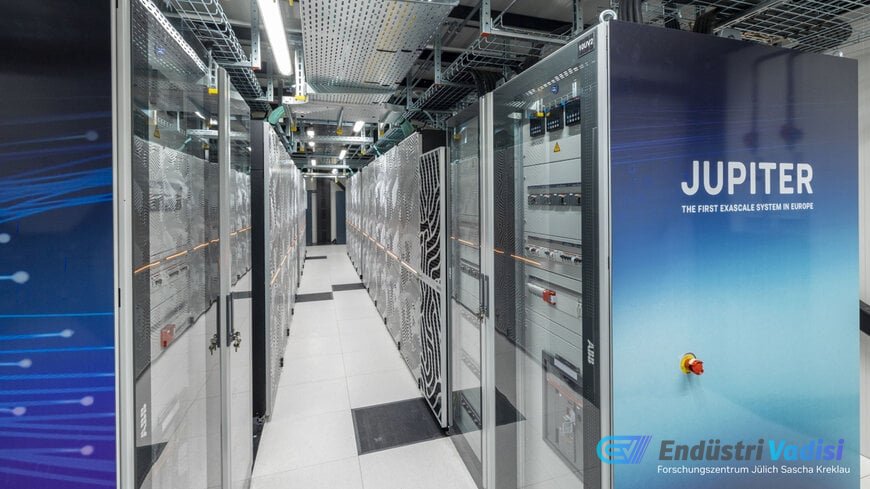
NVIDIA has achieved a breakthrough with a 104-qubit quantum simulation performed on JUPITER, Europe's first exascale supercomputer. This accomplishment validates the "magic state distillation" method, which reduces the physical qubit requirements for fault-tolerant quantum architectures by 90%.
🔬 Resource Efficiency with Magic State Distillation
For quantum computers to become practical, challenges such as physical decoherence and environmental noise must be overcome. Fault-correction architectures use large clusters of physical qubits to create stable logical qubits. The generation and purification of "magic states," which are continuously consumed for universal quantum logic operations, represent a significant engineering bottleneck. Traditional methods can consume up to 90% of total quantum processor resources.
To reduce this resource burden, NVIDIA and the Jülich Supercomputing Centre conducted the most comprehensive fault-tolerant quantum processor simulation to date on JUPITER. The simulation successfully modeled a 104-qubit system subjected to realistic hardware noise, proving that the magic state distillation methodology reduces the number of physical qubits by 90% compared to previous methods.
🧪 Advanced Simulation Under Realistic Conditions
While previous research modeled 50 qubits under idealized, noiseless conditions, this new achievement evaluated magic state distillation under realistic environmental noise and gate infidelity. Capturing error propagation across 104 interacting qubits provides researchers with high-fidelity data to predict how physical processors will execute fault-tolerant algorithms. This, in turn, accelerates engineering cycles for applications in areas such as molecular material design, financial modeling, and drug discovery.
💡 Insights from NVIDIA and Jülich Leaders
- Jensen Huang (NVIDIA CEO): "Practical quantum computing requires complex fault-tolerant systems. Understanding physical behavior at scale on GPU supercomputers accelerates the realization of useful quantum applications."
- Kristel Michielsen (Director, Jülich Supercomputing Centre): "JUPITER's exascale infrastructure provides researchers with the computational capacity to validate quantum processor designs and inform hardware decisions prior to production."
💻 Incremental Development and Exascale Power
Quantum state vector simulations experience exponential memory scaling, with memory requirements doubling with each additional qubit. Simulating a 104-qubit fault-corrected system exceeds the memory capacity of conventional distributed computing clusters. To manage this computational demand, researchers used an incremental algorithmic development pipeline.
Initial simulation models were developed, benchmarked, and debugged on an NVIDIA GB200 NVL72 rack-scale system at the NVIDIA Accelerated Quantum Research Center (NVAQC). This facility allowed the research team to incrementally scale quantum simulation routines from four graphics processing units to hundreds of nodes.
Once baseline convergence was achieved, the workflow was transferred to the JUPITER exascale supercomputer, and the 104-qubit simulation workload was distributed across 8,192 NVIDIA GH200 Grace Hopper Superchips. The simulation was run using NVIDIA cuQuantum software to optimize performance and scale, and the fault-tolerant logical layer of the NVIDIA CUDA-Q platform to formulate the magic state circuit. This layered execution architecture compressed weeks of continuous simulation time into a few days, establishing a repeatable template for validating large-scale quantum error correction codes on accelerated exascale supercomputing infrastructures.
🌐 The Future of Quantum Computing
Universal fault-tolerant quantum computing relies on the Eastin-Knill theorem. This theorem states that no quantum error correction code can implement a transversal, continuous universal gate set without introducing non-Clifford operations. To perform the standard T-gate phase rotations required for universal computation, surface codes and planar lattice architectures must use pre-synthesized magic states. Traditional Bravyi-Kitaev magic state distillation routines take fifteen noisy input states to produce a single purified target state. This creates a bottleneck, leading to up to 90% of physical qubits in systems like IBM Quantum Heron or Google Sycamore architectures being dedicated entirely to state purification rather than algorithm execution. Magic state distillation overcomes this burden by adaptively entangling code patches and growing source states directly within the fault-tolerant topological code space, bypassing multi-stage distillation factories.
In classical supercomputing benchmarks for quantum simulation, platforms like the cuQuantum software development kit utilize accelerated full state vector emulators via NVLink high-bandwidth inter-GPU networks, as well as tensor network contraction. Benchmarks against competing high-performance quantum simulation frameworks (such as Intel Quantum Simulator, Qiskit Aer, and AMD ROCm-based simulations on the LUMI supercomputer) show that simulating more than 50 entangled qubits under non-unitary Kraus noise operators requires aggregate memory bandwidth exceeding tens of terabytes per second. JUPITER, by coordinating 8,192 GH200 superchips using NVLink and InfiniBand fabrics, provides the total memory capacity and coherent memory interconnects necessary to compute non-Clifford noise trajectories without truncating quantum entanglement witness parameters.





















