Hasan S. Cemkan
Corporate
- Thread Author
- #1

💡 Increased Efficiency in Engineering with AI and Cloud
Eplan believes that artificial intelligence, cloud services, and automation will make engineering processes more efficient. However, according to Jan Fleming, Vice President of Customer Journey at Eplan, this is only part of the challenge.
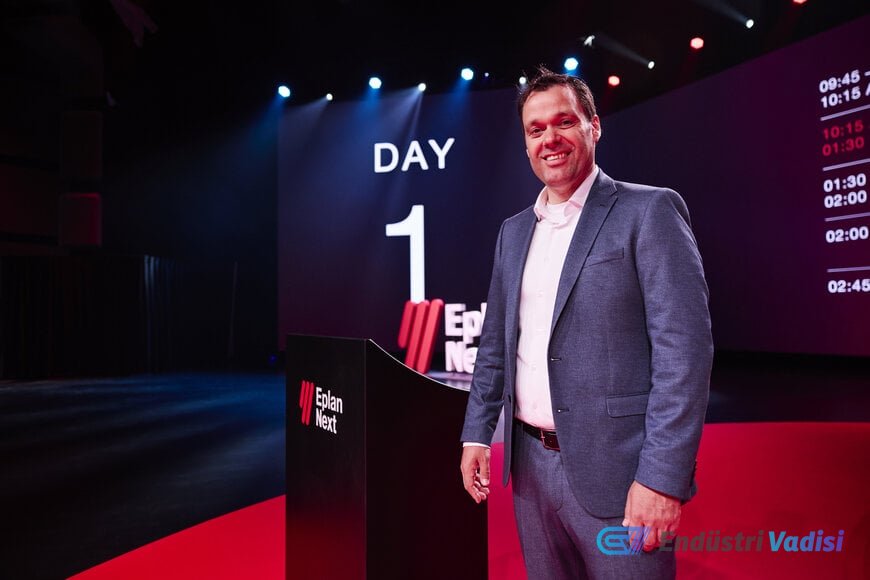
🌍 Eplan Next26: A Global Engineering Gathering
The Eplan Next26 event, held in Munich in May, hosted approximately 1,500 participants from 36 countries. New products, a Future Lab, and a Partner Area were introduced at the event. Jan Fleming emphasized Eplan's role as a bridge between different players in the industry: "All connections, from component manufacturers to machine and plant system manufacturers, and from there to operators, will become even more intertwined in the future." The goal is to create seamless, end-to-end processes from planning to operations.
🤖 Eplan Copilot: The Smart Assistant for Engineering
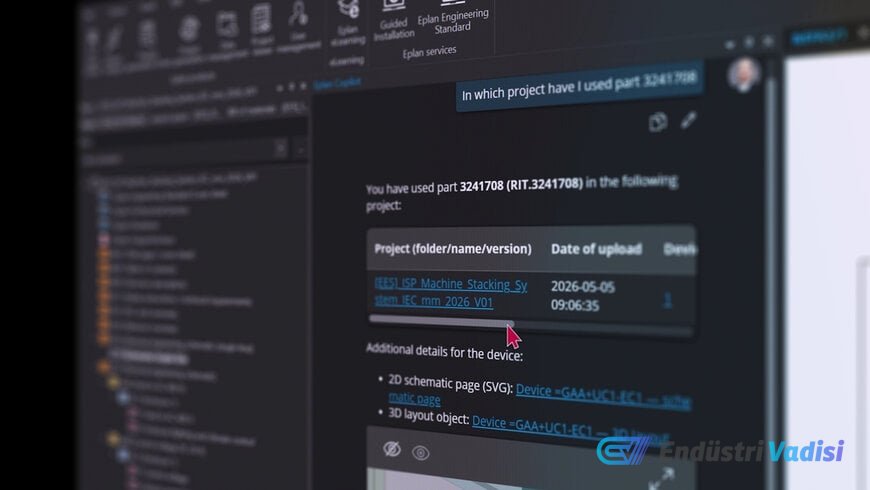
The launch of Eplan Copilot brings together engineering knowledge, platform functionality, and specific tasks using natural language. For example, when an engineer wants to find out which projects a specific component has been used in, they can simply enter the part number and search across all projects stored in the cloud. Fleming states that with this approach, they aim to enable users to quickly navigate Eplan software and easily access the information and functions they need.
Eplan draws a clear line between providing assistance and taking over autonomously. Copilot will initially leverage verified Eplan expertise. In the future, information from partner companies, customers, and standards will also be included. Fleming emphasizes that results in engineering must be repeatable and reliable. Therefore, Copilot does not work with randomly collected information from the internet. The vision is for this system, which starts as a co-pilot, to gradually evolve into an autonomous pilot with an expanded knowledge base and additional capabilities.
🚀 Eplan Platform 2027: A Data-Driven Future
Eplan Platform 2027, available from the beginning of September, was developed based on approximately five hundred customer requests. Fleming speaks of an "unconditionally user-friendly" interface. New functions in Eplan Preplanning, Eplan Electric P8, and Eplan Pro Panel aim to simplify and further automate steps in the planning process, including preplanning and 3D project creation. Fleming sees this release as much more than a traditional software update: "The core benefit Eplan provides to companies is scalability; that is, making it manageable to complete more projects and more variants with existing resources."
This also includes systematically organizing reuse. Rule-based project creation can provide significant efficiency gains without the need for artificial intelligence. Fleming says, "Scaling doesn't just start with AI. When we standardize, reuse, and automatically combine functions, we gain speed and quality, and at the same time, we alleviate the shortage of skilled workers."
At the same time, data management in the cloud is becoming strategically more important. Project data, master data, and device data can no longer be treated as separate entities. With Eplan Platform 2027, the synchronization of master data and device data via the Eplan Cloud will become an even more integral part of the workflow. Fleming explains, "For us, end-to-end means that data does not stop at the boundaries of a single application." The goal, therefore, is more than just a more user-friendly interface. The platform will become a consistent and comprehensive data foundation for subsequent process steps.
At Eplan Next26, Eaton demonstrated how deeply this data foundation can extend into downstream processes. In a switchgear plant in China, the Eplan Platform forms the backbone of the company's electrical engineering. Here, humanoid robots use cameras to inspect wiring and verify that labeling matches engineering documentation. Fleming sees this not just as a spectacular AI use case: "The robot scans the cabinet, compares the labeling with the schematics, and identifies incorrectly labeled or incorrectly connected connections. This shows the advantages that clean engineering data can provide, right up to quality assurance."
🔗 Standards Transform Data into a Process Chain
Eplan Smart Sourcing, introduced at Next26, demonstrates how well this process can work. This solution connects electrical engineering and procurement: During the planning phase, engineers can check whether the required components can be sourced from connected manufacturers and distributors and find out when they can be delivered. Critical parts can be replaced earlier in the process, and verified bills of materials can be transferred to the procurement department. Fleming says, "Smart Sourcing is a great example of how we close the gap in the end-to-end process. It directly links a technical decision made in engineering with actual availability in the supply chain."
Of course, such connections only work when the participating systems speak the same language. Therefore, open standards are central to Eplan's strategy. Fleming states, "AI is not very useful without clean and standardized data." The Asset Administration Shell (AAS) is designed to ensure that data can be transferred in a structured, manufacturer-independent manner. ECLASS Advanced provides an important semantic basis for this. The Industrial Digital Twin Association (IDTA) uses AAS to define the structure, interfaces, and semantics for a standardized digital twin.
This is not just a matter of standardization for Eplan. The Data Portal currently contains over 4 million static and configurable device specifications from more than 550 manufacturers. When such data is available in a standardized format, it can be used, reused, and automatically processed not only in schematics but also in additional process steps. Fleming says, "Data can only become a real productivity driver when it is open and can be reused without the need for translation or reformatting." According to him, the cloud, AI, and AAS are not separate technology trends, but building blocks of the same end-to-end architecture.