




Alper Aktaş
Endüstri Vadisi
- Thread Author
- #1
For years, digital twins were merely impressive 3D models. But that era is over! Factories are now integrating their virtual counterparts directly with live machines, sensors, and supply chains. This means a decision made on a control panel can translate into a tangible change on the production line within seconds.
💰 Market Size and Investments
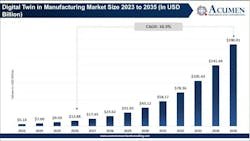
This transformation is also reverberating in financial markets. According to Acumen Research & Consulting, the global digital twin market, valued at $9.5 billion in 2025, is projected to reach $190 billion by 2035. This represents a 20-fold increase in a decade, a clear indication that digital twins are no longer an experiment.
🧠 From a Pretty Model to a Live Factory Brain
A modern digital twin is not just a drawing. It's a continuously updated mirror of a machine, a production line, or an entire factory, fed by vibration sensors, energy meters, quality cameras, and ERP data. When this mirror shows a bearing running 3 degrees hotter than normal, the system can slow the line, reschedule maintenance, and reorder a part before a breakdown occurs.
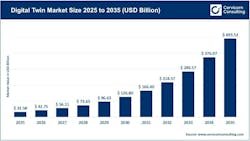
According to Cervicorn Consulting's analysis, the global digital twin market, valued at $32.6 billion in 2025, is projected to reach approximately $493.5 billion by 2035. North America leads this market with a 35.6% share. This leadership is due to a strong base of industrial software suppliers, major aerospace, automotive, and semiconductor manufacturers, and robust federal support for domestic manufacturing.
🌍 Global Investment Map
Public investments in smart factories are increasing across all continents:
- US CHIPS and Science Act: $52.7 billion (from 2022)
- European Union Digital Europe Program: €7.5 billion (2021-2027)
- India Production-Linked Incentive Schemes: Approximately $24 billion (from 2020)
Siemens' 2024 downtime study estimates that the world's top 500 companies lose approximately $1.4 trillion annually due to unplanned outages. McKinsey states that predictive maintenance can reduce downtime by 30% to 50%. BMW announced that it achieved up to 30% increases in planning efficiency by virtually planning all its factories.
🎯 Real-Time Decisions of Digital Twins
Digital twins are currently making real-time decisions in five key areas:
- Predictive Maintenance: Parts are replaced when wear accelerates, reducing downtime by 30-50%.
- Dynamic Scheduling: An urgent order or a delayed supplier triggers dozens of simulated schedules within minutes, and the best one is chosen.
- Energy Optimization: As power costs and carbon reporting rules tighten, heavy loads are shifted to cheaper hours.
- Quality Control: A defect is traced back to the setting causing the deviation before more scrap is produced.
- Worker Safety: Robot and human movements are tested in a virtual cell before anyone steps onto the shop floor.
🗓️ 12-Month Roadmap for Smart Industry Stakeholders
Leaders who view the digital twin not as an IT purchase but as an operations program are achieving success:
- Days 1-30: Choose the most costly problem. Record key data such as unplanned downtime, scrap rate, and energy usage per kWh.
- Days 31-90: Connect and clean the data. Audit data streams from existing machines and identify those requiring sensors. Consolidate maintenance, quality, and scheduling records into a single source.
- Days 91-180: Run a live pilot project with a concrete goal. Set a measurable target, such as a 20% reduction in unplanned downtime within six months.
- Days 181-365: Scale and secure. Replicate the model on similar lines and then in a second facility. Segment the factory network and define access rules.
📊 Your Report Card for the Board
- Unplanned downtime hours month-over-month
- First pass yield and cost of scrap
- Energy consumed per unit produced
- Payback period of the pilot line (target under 18 months)
Digital twins have moved from presentation rooms to the control loop. Market forecasts point to a value of $190 billion for manufacturing alone by 2035, while governments are also supporting factory modernization. The question is no longer whether to build a twin, but how quickly you will allow your factory's digital twins to make critical decisions.