



Elif Özaksu
Corporate
- Thread Author
- #1
🚨 End Alarm Fatigue!
Industrial facilities are overwhelmed with thousands of low-priority equipment alerts. Traditional systems only report threshold exceedances, failing to capture operational impact, correlate sensor data, or record technicians' diagnostic steps. This prolongs unplanned downtime and leads to the loss of critical engineering knowledge as experienced personnel depart.
💡 TwinThread Anomaly Action Center is on the Field!
TwinThread has launched the Anomaly Action Center to address these corporate inefficiencies. This AI-powered solution is designed to collect, prioritize, and resolve operational anomalies across global assets. By integrating directly into existing plant software ecosystems (including CMMS and QMS), it bridges the gap between raw data collection and actionable in-plant response.
🧠 Algorithmic Prioritization and Intelligent Design
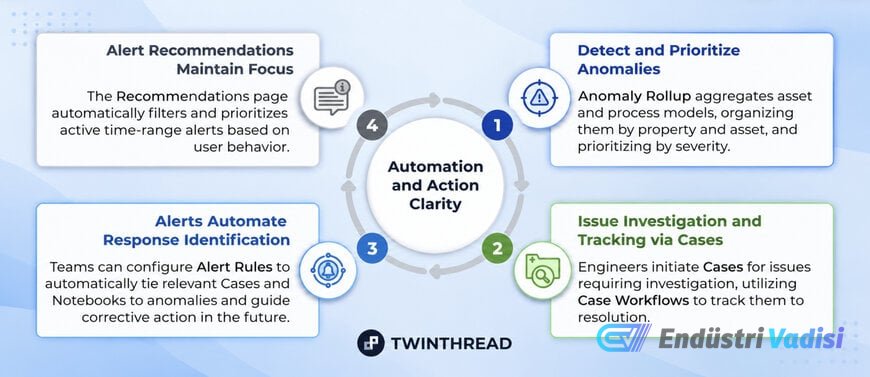
The Anomaly Action Center's mechanism is based on anomaly collection algorithms that combine asset health models with process performance data. The system prioritizes each alert using two key metrics: persistence (how long the condition lasts) and magnitude (deviation from ideal operating limits). Configurable scoring thresholds, topic grouping, and alert buffer zones filter out low-priority anomalies to avoid distracting operators.
Furthermore, the system provides personalized alert recommendations that adapt to user interaction history. This means alerts that a specific engineer or technician typically works on are moved to the top of the list, while notifications previously ignored are deprioritized.
📝 Structured Reviews and Semi-Autonomous Workflows
When a high-priority anomaly arises, the Anomaly Action Center provides a concise, single-sentence summary to the responsible engineer, maintenance technician, or operator. Plant personnel follow reviews through built-in cases and case workflows to provide a standardized approach to root cause analysis.
Once a solution is identified, the team documents the fix as a standard operating procedure in an integrated notebook. These captured procedures form the basis of semi-autonomous resolution. Organizations can configure alert rules with layered criticality that automatically append relevant historical cases and standard operating procedures as soon as a specific threshold is exceeded. This automation directs recurring issues to the relevant personnel with pre-approved corrective actions.
🏭 Industrial Use Cases and Operational Impact
In large-scale manufacturing and process deployments, the platform has proven its ability to manage high-density sensor arrays. In a representative industrial deployment, the platform successfully integrated 80 active predictive models spanning multiple departments, with individual models simultaneously monitoring up to 1,500 different operational sensors.
By transforming ad-hoc troubleshooting into structured, repeatable workflows, the solution reduces repair time, minimizes catastrophic equipment failures, and scales human expertise across multiple facilities. As TwinThread co-founder and CEO Erik Udstuen states, the platform allows teams to skip data collection and focus directly on anomalies that threaten throughput, quality, and uptime.