








Erkan Teskancan
Corporate
- Thread Author
- #1
🤖 The Image Processing Revolution in Autonomous Systems
Autonomous systems, mobile robots, and industrial automation platforms require high-bandwidth, low-latency visual perception pipelines to interpret dynamic environments in real-time. Simultaneously processing uncompressed high-resolution data streams from multiple cameras places significant demands on embedded computing architectures, especially in terms of data path throughput, synchronization, and thermal dissipation in edge computing.
💡 Innovative Solution from SINTRONES
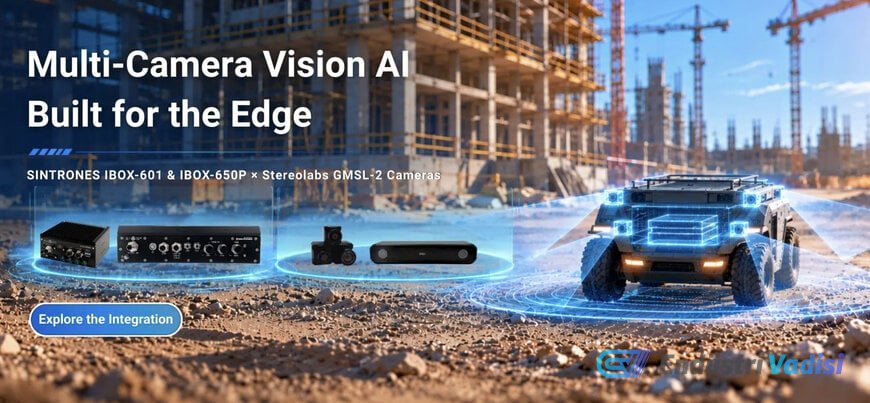
To overcome these engineering challenges, SINTRONES Technology Corp. announces that its NVIDIA Jetson AGX Orin-powered IBOX-650P and Jetson Orin NX-powered IBOX-601 series now support multi-camera integration with Stereolabs GMSL-2 cameras. This hardware integration provides system integrators with scalable options for multi-camera image processing AI deployments in areas such as industrial automation, robotics, autonomous vehicles, and intelligent surveillance.
⚡ High Performance with GMSL-2 Architecture
The IBOX-650P and IBOX-601 platforms integrate Analog Devices GMSL-2 deserialization technology to manage high-bandwidth, uncompressed video streams. The GMSL-2 architecture allows for cable lengths of up to 15 meters over coaxial cable while maintaining low-latency, synchronized data transmission, which is critical for multi-perspective machine vision systems.
Supported configurations can accommodate up to four GMSL-2 camera connections. Verified compatible camera models include the Stereolabs ZED X Stereo and ZED X One 4K, S, and GS variants. This compatibility allows developers to combine 3D stereo depth perception with high-resolution 2D monocular imaging on a single edge computing platform.
👁️🗨️ Synchronized 3D Depth and 2D Monocular Processing
The integration enables dual-mode image processing by pairing the ZED X Stereo camera with ZED X One monocular units. The ZED X Stereo features a dual-lens and global shutter sensor for capturing distortion-free 3D depth data while in motion, enabling precise object tracking and spatial mapping. Simultaneously, the ZED X One S and GS models use global shutter sensors to eliminate motion blur, while the ZED X One 4K provides high-resolution imaging in low-light conditions using a 4K rolling shutter sensor.
This combination enables continuous, low-latency data capture for edge AI inference models running on the underlying NVIDIA Jetson architecture. System integrators can leverage the heterogeneous computing capabilities of the Jetson AGX Orin and Orin NX modules to process parallel neural networks for object detection, depth estimation, and semantic segmentation without experiencing performance bottlenecks.
🏭 Industrial Deployment Scenarios
The IBOX-650P and IBOX-601 series are designed for deployment in harsh industrial and mobile environments that require fanless thermal design and robust mechanical durability. Typical application areas include autonomous mobile robots navigating complex warehouse floors, intelligent transportation systems requiring 360-degree environmental surveillance, and automated optical inspection systems in advanced manufacturing lines.
Traditional USB or Ethernet-based multi-camera setups often suffer from bandwidth saturation, high CPU load for packet processing, and unreliable cable connections under mechanical stress. GMSL-2 technology resolves these limitations by providing dedicated high-speed serial point-to-point links with embedded power and control channels over a single coaxial cable.
Compared to conventional Gigabit Ethernet vision systems, GMSL-2 architectures offer lower protocol overhead and deterministic frame synchronization across multiple sensors. This precise hardware-level synchronization is vital for stereo-SLAM and multi-camera sensor fusion algorithms, where microsecond-level timing differences between frames can lead to significant spatial mapping errors in fast-moving autonomous systems.



















