








Hasan S. Cemkan
Corporate
- Thread Author
- #1
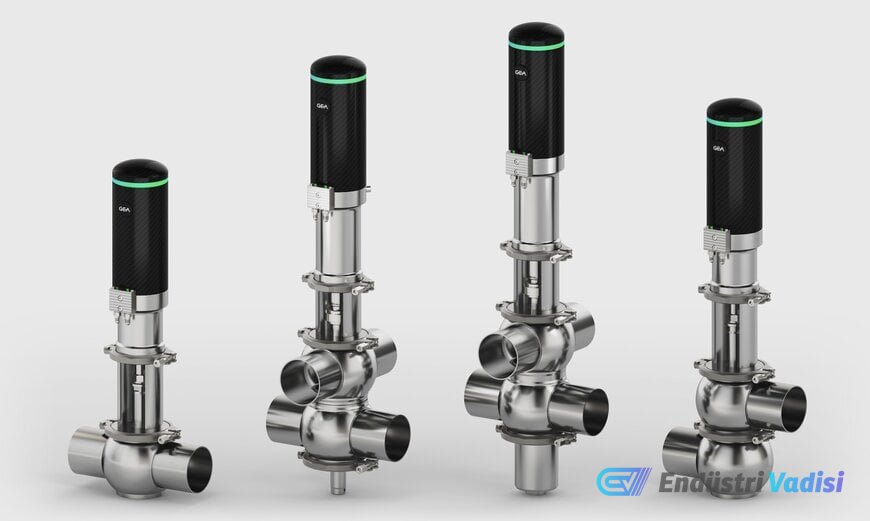
Innovative Solution from GEA: Water-Hydraulic Actuation Technology
GEA is ushering in a new era for beverage manufacturers by integrating closed-circuit water-hydraulic actuation technology into its modular valve portfolio. This innovation significantly reduces reliance on compressed air while substantially increasing the precision of in-line blending.
⚙️ How Does It Work?
Unlike traditional pneumatic systems, this technology relies on a closed hydraulic circuit that uses treated water or an approved water-glycol mixture instead of compressed air. Thanks to the virtually incompressible nature of the hydraulic fluid, the valve position is maintained with absolute precision despite fluctuating process pressures and flow rates. A central pump station supplies hydraulic fluid to the valves. This mechanical stability offers high control accuracy in continuous flow tasks, eliminating the positioning delays experienced by pneumatic systems due to air compressibility.
🍹 Continuous In-Line Blending and Tank Efficiency
In beverage production, precise valve positioning enables continuous in-line blending. Product streams can be dynamically combined, allowing a common base liquid to remain in the process line for longer, while specific product variants can be blended directly into the filling line. At Carlsberg's facility in Denmark, this mechanism keeps Brix, alcohol, and carbon dioxide levels stable despite flow rate fluctuations.
Implementing this architecture in a new plant reduces the number of bright beer tanks from 26 to 14, while increasing average tank utilization from 54% to 90%. Furthermore, production times until filling decrease from weeks to hours, which proportionally reduces the cleaning effort and costs associated with holding multiple finished product variants in parallel.
⚡ Energy Savings and System Integration
The transition from pneumatic systems to hydraulic actuation eliminates the electrical energy required to compress air for continuous valve operations. Industrial measurements from the Carlsberg application show a 95% reduction in power consumption for valve actuation. In new plant designs, this allows engineers to specify a much smaller compressed air infrastructure.
Hydraulic components are not limited to new projects; operators can apply this technology to existing process valves and operate them alongside pneumatically actuated valves in the same plant.
Bastian Tolle, Head of Business Development and Digitalization for GEA's Valve and Pump unit, states that precise valve control enables more efficient use of existing tanks by delaying product differentiation and allows new plants to be planned with less buffer capacity. Anders Kokholm, Director of Brewing Production and Quality at Carlsberg Supply Company, adds that closed, precisely regulated valves enable on-demand production and minimize liquid waste in the bottling plant.
This actuation technology will be launched with integration into single-seat (N-type), change-over (W-type), and double-seat (R and D types) valves. The hardware will be showcased at BrauBeviale 2026, taking place from November 10-12, 2026, in Nuremberg, Germany, in Hall 9, Stand 362.
🔍 Technical Comparison
In the hygienic process valve market, GEA's water-hydraulic actuation competes with both advanced pneumatic systems and electromotor actuators. Market leaders like Alfa Laval and SPX FLOW optimize older pneumatic actuation by using digital control units to minimize air consumption. However, pneumatic systems are fundamentally based on compressible air, which can lead to positioning delays during continuous in-line blending. To completely eliminate compressed air, manufacturers like Bürkert use electromotor actuators, which, like GEA's Hydract, provide absolute mechanical locking force and consume energy only during the actuation stroke. While electromotor valves require decentralized electrical cabling to each unit, the Hydract system relies on a localized fluid pump, making water-hydraulics particularly suitable for dense valve matrices that require high locking forces against fluctuating line pressures.




















