






Hasan S. Cemkan
Corporate
- Thread Author
- #1
🚗 A New Era for Charging Stations!
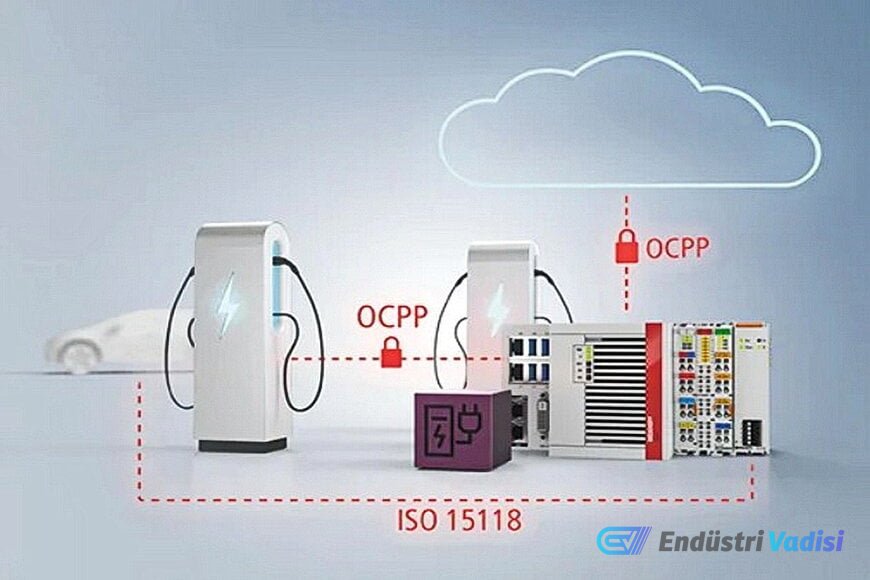
Electric vehicle charging infrastructure has historically been complex due to incompatibilities between stations, grid operators, and backend management platforms. However, Beckhoff is standardizing EV charge management and vehicle-to-grid communication by integrating OCPP (Open Charge Point Protocol) communication via TwinCAT 3 and the EL6761 EtherCAT Terminal to solve this problem.
💡 All Control on a Single Platform!
Beckhoff's new solution unifies station control, grid interaction, and backend communication within an industrial automotive data ecosystem. This eliminates engineering challenges between real-time low-level signaling and cloud-based supply chain logistics and energy accounting. Now, all operational control and network communication are combined in a deterministic hardware environment with a single industrial PC-based automation stack.
⚙️ Operating Mechanism and Protocol Architecture
- TwinCAT 3 IoT OCPP (TF6771): This software offers an OCPP interface via a C++ driver and an integrated PLC library.
- Secure Communication: Uses WebSockets for secure transport, as required by modern network management stations.
- Broad Compatibility: Supports both OCPP 1.6 and OCPP 2.0.1 profiles, maintaining compatibility with older systems while also supporting advanced encryption, smart charging topologies, and transaction diagnostics.
- Physical Connection: The EL6761 1-channel EtherCAT Terminal mounts directly to the DIN rail automation rack and manages low-level signaling standards:
IEC 61851: Pulse width modulation signaling for basic pilot control, status detection, and safety interlocks.
- ISO 15118: Supports high-level bidirectional data exchange for dynamic power negotiation, vehicle identification, and automatic authorization via power line communication over the control pilot line.
🌍 Industrial Topologies and Deployment Models
This integrated software and terminal architecture supports two different operational frameworks:
- Endpoint Configuration: The TwinCAT controller functions directly as a real-time charge point manager. Together with the EL6761 EtherCAT Terminal, it monitors electrical hardware, executes safety loops, interfaces with the vehicle, and connects as an OCPP client to a central management system.
- Supervisor Configuration: TwinCAT acts as a regional controller or intermediate node within the charging network. In this mode, it receives status and telemetry via OCPP from downstream charging stations, coordinating local load shedding, peak shaving, and energy distribution with on-site battery storage or photovoltaic systems. At the same time, TwinCAT interfaces upstream with higher-level billing, authentication, and enterprise energy management software.
🚀 Superiority Over Traditional Systems
Traditional electric vehicle supply equipment designs often fragment control logic. However, Beckhoff's modular approach executes both vehicle-to-charger protocols (IEC 61851/ISO 15118) and charger-to-cloud interfaces (OCPP 1.6/2.0.1) within a single IPC runtime. The ISO 15118 standard implemented in the EL6761 supports the cryptographic handshake required for automatic "Plug & Charge" applications.
This integrated solution allows power distribution logic to sample grid meter inputs and dynamically curtail vehicle draw in sub-1 millisecond cycle times. This offers grid-compliant balancing that independent, cloud-connected EV chargers cannot emulate.