


Semih Asil
Industry Valley
- Thread Author
- #1
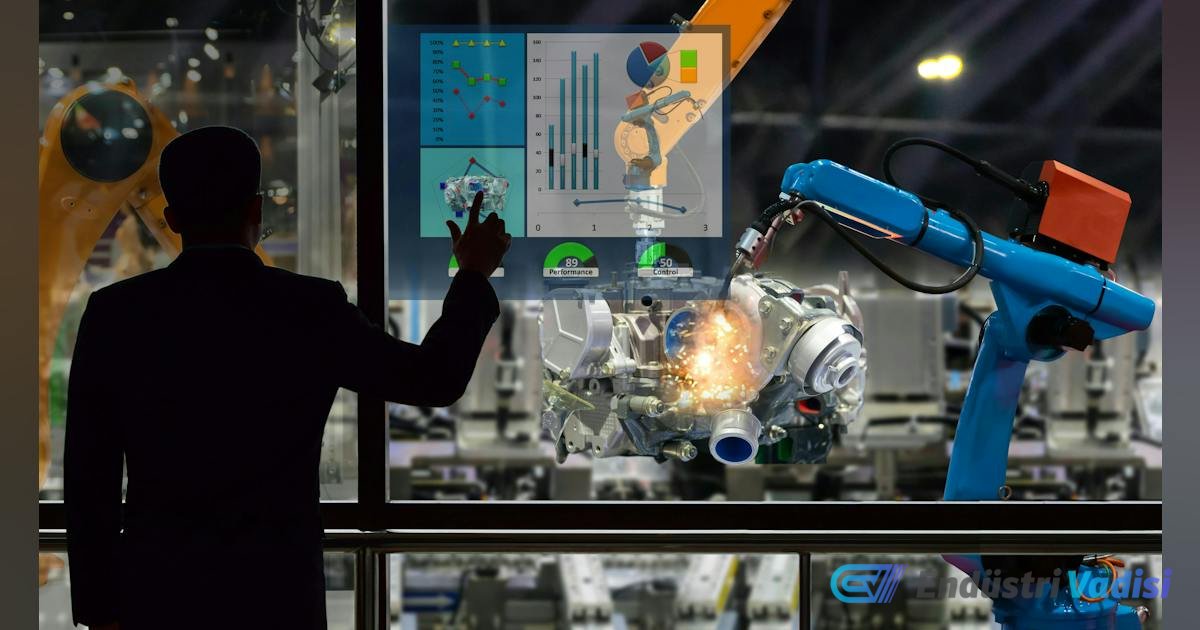
🏭 The "Smart" Concept in Industry and the AI Revolution
For the past two decades, we've added the word "smart" in front of everything in industry: smart factories, smart manufacturing, smart machines, smart supply chains... But were they really smart? What does "smart" even mean?
After billions of dollars invested in Industry 4.0, IoT, machine learning, and digital transformation, these questions might seem provocative. Industrial operations have become more connected, more automated, and richer in data, that's for sure. But perhaps we've been too generous in using the word "smart." Artificial intelligence is making us re-evaluate the meaning of this word.
🔗 Connectivity Is Not Intelligence!
The first generation of the smart factory was fundamentally built on connectivity. Sensors generated data, machines communicated with systems, and IoT platforms collected operational information. This was a huge step forward and delivered real economic value.
Then analytics evolved. Beyond knowing what happened, manufacturers began to predict what might happen. Machine learning detected anomalies, predicted equipment failures, optimized schedules, and uncovered patterns that human operators couldn't see.
Next came automation. Machines could automatically perform predefined actions. Workflows could trigger other workflows. Decisions requiring human intervention could be turned into business rules.
We called all of this "smart." But connectivity is not intelligence. Nor is automation intelligence. A highly automated system can execute the same predefined process thousands of times with extraordinary precision, without understanding why it's doing it. Perhaps much of what we called "smart" was actually advanced automation.
🧠 AI Raises the Bar
Generative AI and agentic AI are fundamentally raising expectations for what industrial intelligence can mean. A connected system can tell us what happened. A predictive system can tell us what might happen. An automated system can execute a predefined response.
But a truly intelligent system should be able to interpret a situation, understand context, evaluate alternatives, reason across conflicting objectives, determine an appropriate course of action, execute that action, and learn from the outcome. This is a very different standard and a greater level of complexity to address.
The evolution of industrial intelligence can be described as a progression from connected to predictive, from predictive to adaptive, from adaptive to agentic, and finally from agentic to increasingly autonomous. The key transition is not just from less automation to more automation, but from executing instructions to participating in decisions. This changes the meaning of the word "smart."
📊 A Dashboard Is Not "Smart"
Industrial companies have invested enormous amounts of money to create visibility. We have control towers, dashboards, digital twins, alerts, predictive models, and advanced visualization tools. But many organizations still rely on humans to connect the dots. Some people are still sitting in old-fashioned control rooms!
A dashboard identifies a problem. Someone interprets it. Another system contains additional information. Someone reconciles the two. A meeting is held. Alternatives are discussed. A decision is made. Someone else enters that decision into another system.
While the technology surrounding the decision can be incredibly sophisticated, the decision-making process remains fragmented and manual. This is why AI represents something more significant than just another analytical technology. AI has the potential to move industrial technology from an information architecture to a decision architecture.
The question is no longer just, "What can the machine tell me?" Increasingly, the question becomes, "How can the machine help us make decisions?"
💡 "Smart" Means Perceiving, Making Sense, Acting, Reasoning, and Transforming
Perhaps we need a higher standard for using the word "smart." A truly smart industrial system should be able to perceive what's happening in its environment. It should be able to make sense of these signals by adding context, rather than just collecting data. It should be able to act when action is appropriate. It should be able to reason across alternatives, constraints, risks, and outcomes. And ultimately, it should be able to transform by learning from outcomes and improving the way things are done.
This doesn't mean removing humans from industrial operations. Quite the opposite. The smartest industrial environments can combine human judgment, machine intelligence, automation, and data in ways that allow each to do what it does best. The goal is not an unmanned factory. The goal should be a factory that can make better decisions.
💰 From Operational Intelligence to Economic Intelligence
A factory can be operationally optimized and still make poor economic decisions. Imagine a smart system identifying an opportunity to increase the throughput of a production line. Technically, increasing throughput might seem optimal. But what if the extra production creates excess inventory? What if energy costs are temporarily high? What if speeding up production increases maintenance requirements? What if customers don't need the extra output?
The technically optimal decision might actually destroy value. In this case, the smartest decision might be to do nothing. This is where the definition of "smart" becomes much more interesting.
Industrial intelligence must move beyond optimizing machines and processes to understanding the economic consequences of decisions. Smart systems must simultaneously consider cost, capacity, customer value, revenue, margin, risk, and opportunity.
The ultimate measure of industrial intelligence is not whether a plant can optimize itself. It's whether it knows what's worth optimizing.
🚀 Time to Raise the Bar
Industry 4.0 has given us extraordinary capabilities. IoT connected the industrial world. Analytics helped us understand it. Machine learning helped us predict it. Automation helped us execute faster and more consistently.
AI offers something different. It offers the possibility of reasoning and action at scale. This means we need to be much more demanding about what deserves to be called "smart."
The next smart factory won't just generate more data, deploy more sensors, automate more processes, or create more dashboards. It will increasingly understand context.