








Erkan Teskancan
Corporate
- Thread Author
- #1
🌟 Technological Marvel: The Flexibility of Linux
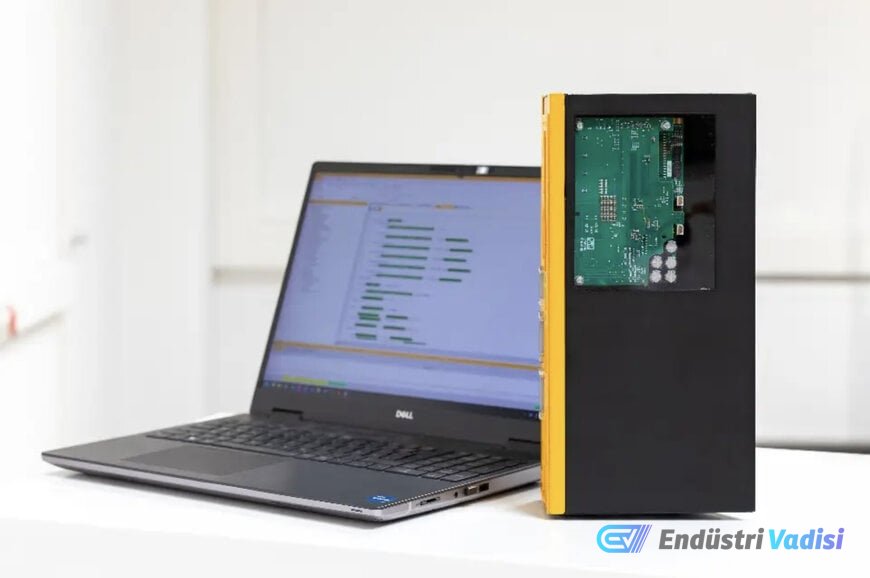
Baumüller is introducing a brand-new Linux-based automation platform for industrial motion control and PLCs! This innovative approach aims to revolutionize the industry by combining centralized and drive-integrated machine automation. Thanks to the open-source Linux kernel, integration with third-party systems is now much easier, providing unlimited flexibility for customer-oriented projects.
⚙️ Distributed Control Architecture and Processor Independence
Modern machine manufacturing requires high-speed and precise coordination, while also needing open interfaces for data-intensive processing and operational analysis. Baumüller's new platform overcomes these challenges with a processor-independent Linux operating environment and an updated ProMaster engineering framework. This creates a unified software basis for both central controllers and b maXX drivePLC units.
Unlike traditional closed systems, Baumüller's architecture separates control algorithms from hardware, allowing real-time control routines, as well as edge microservices, condition monitoring algorithms, and artificial intelligence models, to run on the same hardware. This directly interfaces with b maXX 6000 series servo drives and b maXX drivePLC, locally processing high-frequency drive data for predictive maintenance and anomaly detection without saturating the primary industrial Ethernet data bus.
🎯 Precise Motion Control and Standard Software Frameworks
The platform is designed to be fully compliant with the IEC 61131-3 programming standard. Thanks to PLCopen-compliant motion control function blocks, multi-axis path interpolation, electronic gearing, and camming routines can be transferred between central or distributed drives without code modification.
The updated ProMaster engineering suite combines project planning, parametrization, high-level programming, commissioning, and system diagnostics into a single environment. Key technical features include:
- Object-Oriented Architecture: Engineers can develop modular machine code using object-oriented extensions alongside high-level programming languages like C++.
- Software Reusability: Verified machine modules, technology libraries, and functional templates from previous engineering iterations retain full functionality in the updated architecture.
- Automated Test Routines: Continuous integration protocols enable automated verification of software builds, isolating logic errors and timing anomalies before physical machine commissioning.
🔒 Security and Efficiency at the Forefront
The combination of real-time operating systems with standard Linux distributions in industrial automation is an established trend in the industry, comparable to platforms like Beckhoff TwinCAT, Siemens SIMATIC, and CODESYS-based Linux runtimes. The b maXX drivePLC achieves deterministic task cycles of up to 250 microseconds within the servo inverter, eliminating loop jitter associated with external fieldbus transport for single and dual-axis configurations.
The platform's communication topologies include real-time industrial Ethernet protocols such as EtherCAT and PROFINET IRT, as well as standardized machine-to-cloud connectivity using OPC UA and MQTT protocols. The control hardware in the b maXX 6000 series complies with the Ecodesign Directive (EU) 2019/1781 under the IE2 efficiency classification for drive controllers.
To comply with contemporary machine safety directives, the platform integrates drive-based functional safety protocols (Fail Safe over EtherCAT / PROFIsafe) that meet SIL 3 according to IEC 61508 and PL e according to ISO 13849-1. Furthermore, the implementation of an open Linux environment requires compliance with the industrial automation cybersecurity standard IEC 62443-4-1 and IEC 62443-4-2, which ensures secure boot mechanisms, role-based user authentication, and encrypted parameter transfer throughout the automation lifecycle.





















