







Alper Aktaş
Endüstri Vadisi
- Thread Author
- #1
Synopsys Introduces Autopilot Platform to Automate Engineering Processes!
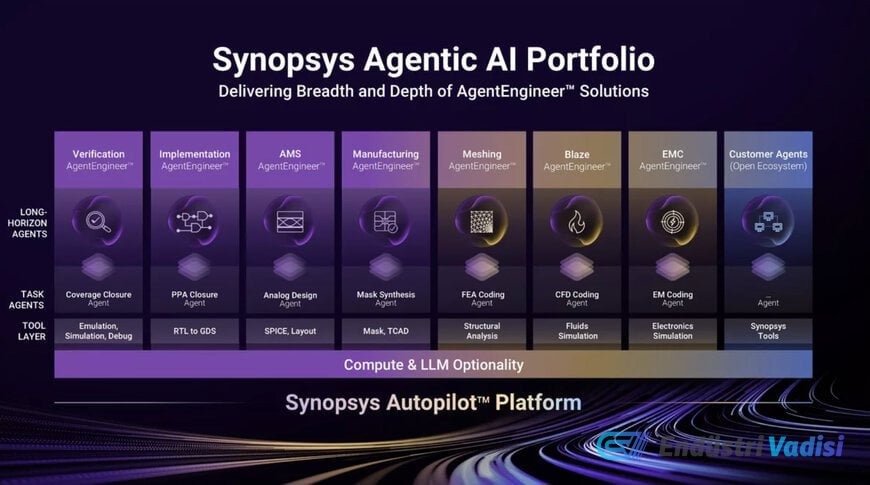
Synopsys has announced its Autopilot Platform and a portfolio of specialized AgentEngineer solutions, designed to automate complex engineering workflows in the semiconductor and system design industries. This innovative platform goes beyond traditional AI applications, offering "super agents" capable of achieving long-term goals, creating plans, and managing end-to-end workflows.
New Architecture Challenges Traditional Approaches
Traditionally, AI applications in electronic design automation focused on isolated tasks such as script generation or code correction, with human engineers guiding the sequence of operations. Synopsys' new architecture changes this paradigm. Now, long-horizon super agents are in play, capable of reasoning about complex engineering goals, formulating plans, orchestrating specialized task agents, and executing end-to-end workflows.
Autopilot Platform: An Open and Secure Foundation
Targeting a wide range of applications from semiconductor manufacturing to chip verification, analog and mixed-signal design to multi-disciplinary system engineering, the Autopilot Platform provides an open and secure foundational layer. This layer integrates contextual intelligence, persistent memory, telemetry, and security governance, directly connecting autonomous agents with core electronic design automation and simulation engines.
Specialized Solution Portfolio and Operational Mechanisms
The platform offers a portfolio covering many functional areas in the digital supply chain and chip development lifecycle:
- Verification AgentEngineer: Manages the verification cycle.
- Implementation AgentEngineer: Coordinates physical design stages.
- AMS AgentEngineer: Automates analog and mixed-signal design workflows.
- Manufacturing, Meshing, Blaze, and EMC AgentEngineers: Addresses areas such as specialized manufacturing mask data preparation, meshing for simulation, gas turbine combustion studies, and printed circuit board electromagnetic compatibility analysis.
Long-horizon agents operating in these areas maintain context across thousands of reasoning steps, dynamically evaluate intermediate results from task agents, and adjust execution paths when outputs deviate from target criteria.
Quantitative Results and Open Architecture
Evaluations with over fifty customers show measurable performance improvements:
- Up to 50x acceleration in verification closure.
- 20% higher coverage.
- Two-fold improvement in token efficiency.
- 10% to 30% productivity increase in register transfer level code generation and refactoring.
The platform supports third-party agents, custom engineering databases, commercial and open-source language models, and flexible deployment models from cloud infrastructure to on-premise servers, enabling integration into heterogeneous enterprise environments. Human oversight mechanisms allow engineering teams to establish mandatory checkpoints to validate decisions and manage autonomous execution. General availability of the platform and agent solutions is planned for late 2026.
Competitive Analysis: The Synopsys Difference
In the autonomous electronic design automation market, major players like Cadence Design Systems and Siemens EDA also use agent-based frameworks to manage multi-step verification and implementation flows. The Synopsys Autopilot Platform differentiates itself with a broad post-merger integration scope by combining traditional silicon electronic design automation tools with Ansys multi-physics and system analysis engines under a unified agent architecture. While traditional tools measure efficiency with local runtime accelerations in single-engine simulations, long-horizon architectures aim for workflow closure by minimizing the human coordination burden required for data transfer between fragmented verification and implementation passes.