




Ahmet Ö.
Corporate
- Thread Author
- #1
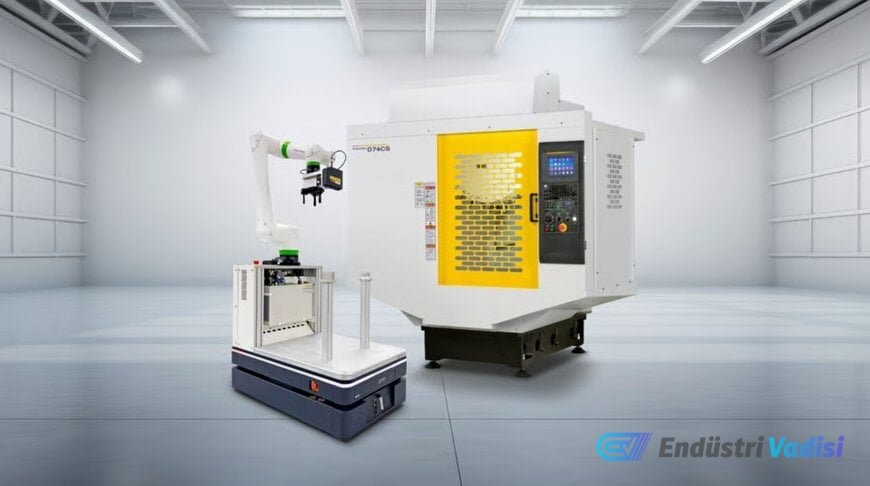
🚀 FANUC Joins Forces with Google Cloud, NVIDIA, and AWS!
FANUC America is collaborating with Google Cloud, NVIDIA, and Amazon Web Services to integrate artificial intelligence, cloud analytics, and physics-based simulation into industrial robotics and CNC systems. This technical collaboration aims to address operational constraints in manufacturing such as high programming costs, long commissioning times, and inflexible production lines unable to adapt to variable workloads.
🛠️ Technical Architecture and Roles of Partners
Deploying AI in factory environments requires combining high-performance computing and multimodal data processing with real-time industrial kinematics.
- Google Cloud: Provides natural language models and multimodal reasoning frameworks. These models process unstructured sensor data and handwritten inputs to automatically generate robot programs and standard Python code, thereby eliminating manual programming processes.
- NVIDIA: Offers physics-based simulation pipelines through its Isaac Sim environment. This architecture integrates Isaac Sim with FANUC's proprietary ROBOGUIDE simulation platform. This bidirectional interface creates a synchronized digital twin that enables motion validation, tool path verification, and collision avoidance prior to physical setup.
- FANUC America: Integrates these software layers directly into hardware controllers such as the R-30iB Mini Plus and R-50iA. The system coordinates image streams, integrated force feedback, and dynamic tracking without the need for external sensing devices.
Amit Goel, head of robotics partnerships at NVIDIA, stated, "Developing and scaling physical AI requires advanced simulation tools that enable robots to learn and validate complex tasks in virtual environments. By integrating NVIDIA Isaac Sim as an open framework within a live digital twin connected to FANUC ROBOGUIDE, FANUC offers developers a faster path to create, test, and deploy AI-driven manufacturing solutions."
🏭 Industrial Applications and Use Cases
The integrated systems are configured for manufacturing environments that require high precision under variable operational conditions:
- Part Picking and Component Sorting: Image streams and natural language commands dynamically guide robotic end-effectors to identify and position mechanical parts.
- Micro-Assembly Operations: Dual-arm CRX-5iA cobots use closed-loop force sensing to perform connector insertions and planetary gear assemblies without manual calibration.
- In-Line Fastening: Visual tracking modules calculate real-time position adjustments on continuous conveying systems, enabling precise bolt tightening on moving components.
- Automotive Manufacturing: High-inertia industrial robots perform resistance spot welding after kinematic sequences have been validated within the virtual twin.
📈 Operational Impact and Validation
The combined simulation and AI application reduces programming times and physical commissioning cycles. Digital twin validation eliminates mechanical collision risks, protects tooling, and verifies surface finish tolerances before metal cutting. Connecting physical site assets to scalable cloud infrastructure via AWS-powered diagnostic systems provides continuous telemetry, enabling condition-based maintenance and reducing unplanned equipment downtime.
Technical configurations of this joint platform are planned for operational demonstration at the International Manufacturing Technology Show (IMTS 2026), to be held in Chicago, Illinois, from September 14-19, 2026.