







Alper Aktaş
Endüstri Vadisi
- Thread Author
- #1

🤖 Practical Solutions Instead of Humanoid Robots in Factories
When you enter today's factories, instead of humanoid robots wandering the corridors, you encounter more concrete and practical applications. A maintenance manager tests a defect detection camera, while an IT leader questions whether a new sensor feed requires corporate approval. Engineers, meanwhile, try to record the unwritten, hands-on experience of a machinist who is about to retire.
This is the true state of physical AI in manufacturing: narrow and practical steps are being taken, rather than a comprehensive transformation.
🧠 Knowledge Retention: The Most Immediate Opportunity
Approximately one-third of the manufacturing workforce is over 55. Much of what these individuals know – the sound a bearing makes just before it fails, the small adjustment that saves a batch – was never written down in a manual. This knowledge lives in their hands.
Manufacturers are now placing AI alongside experienced operators, recording their troubleshooting methods and turning this into a searchable guide for new hires. Some firms are trying to fill the knowledge gap that arises after someone retires or leaves by allowing an employee to demonstrate a task directly to the machine.
Computer-aided manufacturing software has also begun to integrate AI co-pilots. This allows machinists to explain a problem in simple language and receive suggested solutions. This reduces scrap while quietly recording expert knowledge for reuse.
🔍 Small Models, Big Gains: Why Bigger Isn't Always Better?
There's a quiet shift happening in the types of AI factories are buying. While general-purpose models are suitable for drafting and broad questions, the winning tools on the shop floor are small, narrow, and designed for a single task.
For example, a model trained to detect scratches on a single part performs better than a general image model in terms of speed and accuracy, and it runs on an edge camera rather than a remote data center.
Samsung Electronics implemented a system specifically designed for defect detection in semiconductor manufacturing, reporting a 31% reduction in customer returns.
⚙️ Why Does Predictive Maintenance Constantly Need Retraining?
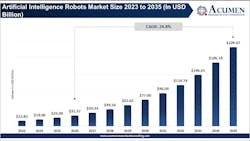
Predictive maintenance is often marketed as a model that is built once and left to run. In practice, however, engineers find they need to retrain much more frequently than vendors promise.
Machine behaviors changed in the post-pandemic era; supplier changes and shifting schedules altered the vibration and thermal patterns that models learned from old data. A model trained with 2019 data might give incorrect results in 2026 on a line running at a different speed with different components.
Renault reported €270 million in savings in a single year thanks to predictive AI applied to energy usage and maintenance scheduling. This figure shows what's possible when models stay current.
🇺🇸 How Is the US Leading This Change?
The United States most clearly demonstrates this model, and investments are increasing fastest here.
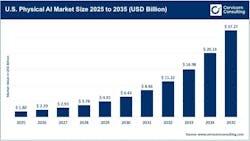
The physical AI market in the US is expected to grow from $1.81 billion in 2025 to $27.3 billion in 2035. Approximately 46% of US manufacturers already use AI tools like chatbots in daily operations, and over 80% expect to expand usage within two years.
Insurers are also reacting to this situation. In January 2026, standard policy forms introduced new liability exclusions for generative AI, and major US insurance companies have received state approval to add similar exclusions to general liability and errors and omissions policies. This means that a tool a vendor sold last year may no longer be covered this year.
🚀 Are Businesses Pursuing the Opportunity, or Just Talking?
The honest answer is partially. A recent survey found that 80% of manufacturers allocate at least 20% of their technology budgets to smart tools, but only one-fifth believe they are ready to deploy AI at scale. Everyone is exploring, but few are implementing.
Spending is also shifting from generative chatbots to narrower, deterministic tools. Quality operations data shows that 47% of manufacturers use AI in quality processes; this is up from 33%, with defect detection and planning optimization among the fastest-growing uses.
Adoption is also happening on a factory-by-factory basis, not company-wide. A factory manager in Ohio who approves a planning optimizer often has no connection to a colleague doing the same in Texas, and corporate IT often learns about these tools after they are already running. This creates governance gaps that insurers and IT leaders are just beginning to notice.
The businesses that stand out are not those with the most ambitious AI strategy documents. They are the ones quietly retraining their maintenance models every quarter instead of every three years, buying a camera that does one job well instead of a platform that promises everything, and recording what their most experienced employees know before they walk out the door.