






Cengiz Özemli
Academic
- Thread Author
- #1
👋 Goodbye "Labeling Parties", Hello Efficiency!
At AlgaeBarn, a Colorado-based aquaculture producer, the process of lid labeling for our nine different product lines used to mean manually applying thousands of labels. While this turned into "labeling parties" bringing our employees together, it was actually a source of operational inefficiency. Our production team had to drop their primary tasks and label when the stock of labeled lids ran low.
💡 Automation Opportunity: Why We Built Our Own System
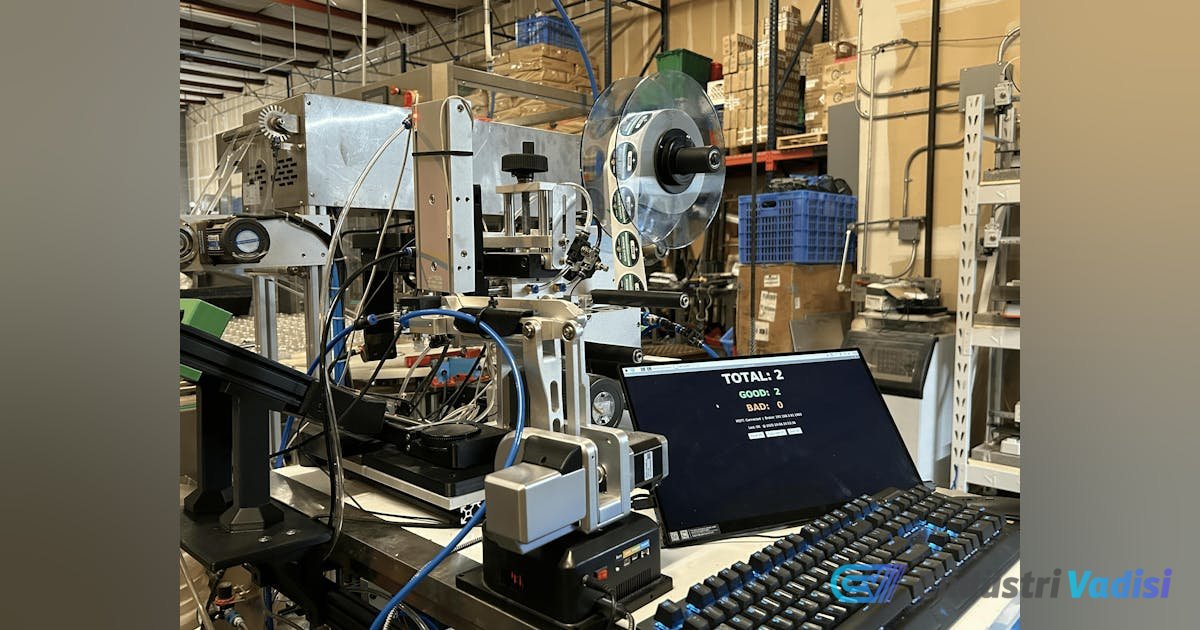
As a Robotics and Automation Engineer, I saw an opportunity to automate this repetitive process. Our goal wasn't just to label faster; it was to create an autonomous cell that could orient lids, apply labels, inspect the result, and separate the finished part without operator supervision.
Although commercial labeling machines were available on the market, we chose to build our own system due to cost and control concerns. Commercial systems often assume that label placement will remain accurate, but this isn't always true in a production environment. Furthermore, we wanted access to the machine's logic so it could evolve with our production needs. Designed using SOLIDWORKS, the hardware cost for this system remained under $1,000. Most importantly, our ability to inspect every lid was far more valuable than simply relying on the initial mechanical setup.
⚙️ How It Works: The Journey from Lid to Inspected Part
- Feeding: The operator empties lids into a dispensing elevator. Sensors engage the elevator conveyor when more lids are needed. Lids are passively oriented; correct ones proceed to the labeling station, while inverted ones fall into a collection bin.
- Positioning: A tray picks up lids one by one. A KEYENCE laser sensor confirms the lid's presence and signals the controller. A pneumatic cylinder brings the lid into position, and reed switches confirm the cylinder has reached its required position.
- Labeling: A geared stepper motor advances the label roll around a peel edge. As the backing paper changes direction, the label separates from the liner. A vacuum-assisted pneumatic applicator picks up the freed label and applies it to the lid.
- Inspection and Separation: The controller sends an MQTT message to a Raspberry Pi equipped with a camera module. A custom OpenCV routine captures an image and evaluates the label's position. Since lid and label dimensions are fixed, the software measures the gap between detected edges and verifies if the placement falls within the selected tolerance. The inspection result returns to the controller, and a robotic arm places the lid into either the accepted parts bin or the rejected parts bin.
🎯 Precision is Everything: The Big Impact of Small Errors
The most challenging engineering hurdle was stopping the label roll in precisely the right spot. While an early motor drive responded to the controller's stop command, residual energy and mechanical inertia caused the shaft to coast. This extra movement was enough to misalign the next label. To solve this, I redesigned the drive around a geared NEMA 24 stepper motor. This change significantly improved consistency and reinforced one of the project's most important lessons: In a production environment, a millimeter is never just a millimeter. Small deviations, when repeated hundreds of times, turn into significant quality issues.
⏱️ Quality Before Speed: 450 Lids Per Hour
The completed system processes approximately 450 lids per hour. This rate meets our production needs, but efficiency wasn't the only measure of success. An operator can load lids, start the machine, and return to their other tasks. If the feeder runs out of lids or the controller detects another abnormal condition, the system stops and sends an alert rather than continuing to produce indeterminate results.
In the initial 100-lid trial, 98 lids met the selected placement tolerance. The other two were rejected due to minor positional differences. As product quality is paramount, the inspection thresholds were intentionally conservative.
This project took approximately four months and eliminated the need for manual labeling. Thanks to reduced manual labor and fewer production interruptions, the system is expected to generate annual labor and efficiency savings of approximately $40,000 to $50,000.
The broader lesson is simple: Start with a real operational need. Before embarking on automation, estimate the time, budget, and expected value, and then design within those constraints. Small manufacturers don't always need the fastest or most expensive equipment. They need reliable systems that solve the right problem, provide feedback when things go wrong, and deliver repeatable quality.