





Hasan S. Cemkan
Corporate
- Thread Author
- #1
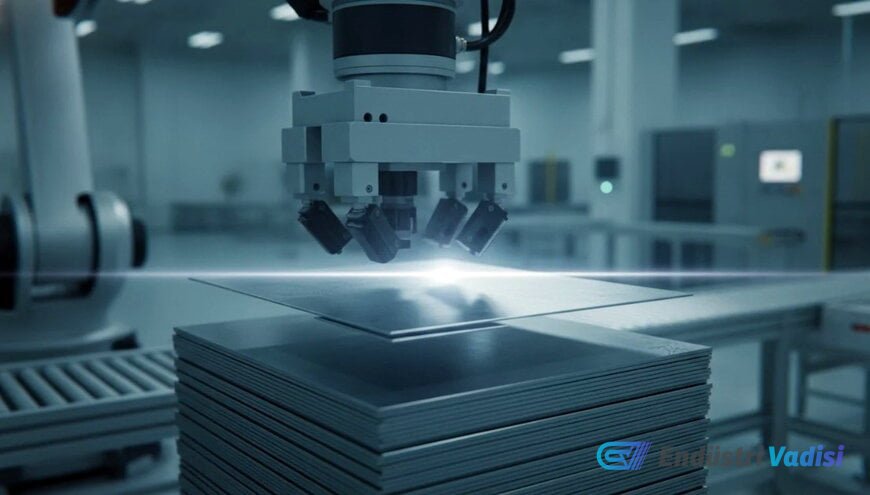
Continuous verification of metal sheet feeds in automatic press lines, stamping cells, and material handling systems is now much safer thanks to Contrinex's smart inductive sensors with IO-Link integration. This system prevents overlapping sheets from being fed into dies simultaneously, eliminating tool damage, unplanned downtime, and material waste.
🛠️ Technical Challenges and Solutions in Sheet Metal Processing 🛠️
Automated metal forming and stamping operations require precise material thickness feeds to maintain process stability. Double sheet feeds can transmit mechanical forces beyond nominal design limits to press tools, leading to punch face breakage, die set misalignment, and structural press damage.
Conventional proximity sensors encounter significant limitations in demanding metalworking environments:
- Process contaminants such as drawing oils, corrosion-inhibiting fluids, and metallic dust can alter signal return, causing false triggers or missed detections.
- Mechanical wear in contact-based sensors compromises calibration and leaves marks on sheet surfaces.
- Sheet thickness variations in mixed-gauge batches can disrupt detection thresholds.
- Airborne debris and weld spatter can degrade standard polymer sensor housings.
Contrinex addresses these operational challenges by utilizing non-contact inductive sensing technology combined with full-metal, stainless steel housings. The non-contact operating principle eliminates mechanical wear and surface abrasion on the target stock, measuring electromagnetic field changes to detect sheet thickness variations without physical contact.
🏗️ Sensor Construction and System Integration 🏗️
The primary sensing element is constructed with a robust, one-piece stainless steel housing designed to withstand mechanical shocks, thermal fluctuations, and continuous vibration. Specialized variants include anti-spatter coatings to prevent weld spatter adhesion in automated welding cells.
Contrinex provides the sensor hardware, embedded software, and interface configuration tools. The physical sensor housing integrates the sensing coils, internal signal processing electronics, and standard IO-Link communication interfaces into a unified physical package.
The sensor system connects directly to standard programmable logic controllers (PLCs) via a point-to-point IO-Link digital interface. System setup and parameter calibration are performed via the PocketCodr interface, a software-assisted configuration tool that enables precise parameterization without manual programming.
📊 Digital Communication and Processing Workflow 📊
Operational data flows from the sensor through two main integration pathways:
- IO-Link Communication: Digital signal telemetry, operational diagnostics, and signal drift trends are continuously transmitted to higher-level automation systems.
- Codeless Parameterization: Configuration parameters are defined via PocketCodr recipes according to specific sheet gauges and material properties.
- Predictive Maintenance Diagnostics: Continuous signal monitoring identifies optical or structural interference before operational failure occurs, allowing maintenance teams to intervene during planned service windows.
- Recipe Management: Custom parameter profiles are saved externally and reloaded directly onto replacement units, bypassing physical recalibration steps.
🚀 Operational Impact and Process Flow 🚀
Intelligent double sheet detection is positioned upstream of the primary press feed line to verify incoming stock before die insertion. If an overlapping sheet condition is detected, the sensor system immediately sends a stop command to the PLC, disengaging the feed mechanism before the die cycle begins.
This system configuration provides specific operational performance advantages:
- Equipment Protection: Direct prevention of die face breakage, punch shearing, and press frame deformation.
- Reduced Downtime: Accelerated changeover intervals thanks to stored parameter recipes and zero mechanical sensor wear.
- Process Reliability: Material-independent measurement ensures stable thickness differentiation between thin foils, medium-gauge blanks, and heavy plates despite surface oil or residue.