








Mucitler Elektrik
Corporate
- Thread Author
- #1
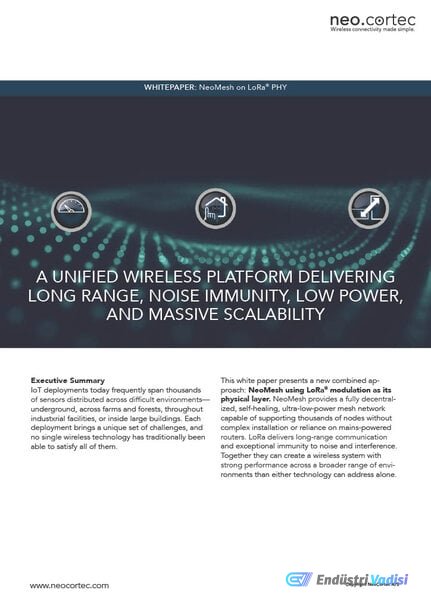
NeoCortec, a producer of ultra-low-power bi-directional wireless mesh protocol stacks, has released a new technical report detailing LoRa® modulation as the physical layer for its NeoMesh technology. The report, available on the company's website, examines how combining NeoMesh with LoRa® addresses the demands of modern Internet of Things (IoT) deployments operating in challenging environments.
🌐 Technical Synergy and Network Architecture
NeoMesh offers a fully decentralized, self-healing, ultra-low-power mesh network capable of supporting thousands of nodes without the need for complex setup procedures or mains-powered routers. By utilizing LoRa® modulation as the physical layer, the platform gains long-range communication capabilities and exceptional immunity to noise and interference. This combination creates a wireless system designed to perform in environments such as underground spaces, agricultural fields, forests, industrial facilities, and large multi-story buildings, which single technologies struggle to address alone.
💡 Why It Matters?
Traditional networks often face trade-offs between node density, power consumption, and transmission range, while standard LoRaWAN deployments typically rely on a star-of-stars topology connected to central gateways. By embedding LoRa® modulation directly into a decentralized, peer-to-peer mesh architecture like NeoMesh, developers can bypass single-point-of-failure gateway bottlenecks and extend coverage over vast physical areas using ultra-low-power node hopping. This approach positions NeoCortec among specialized wireless innovators where battery life and reliable signal propagation through dense physical obstacles are critical, such as in industrial IoT, smart metering, and remote agricultural automation.























