





Hasan S. Cemkan
Corporate
- Thread Author
- #1
Emerson Integrates AI into Automation Platform
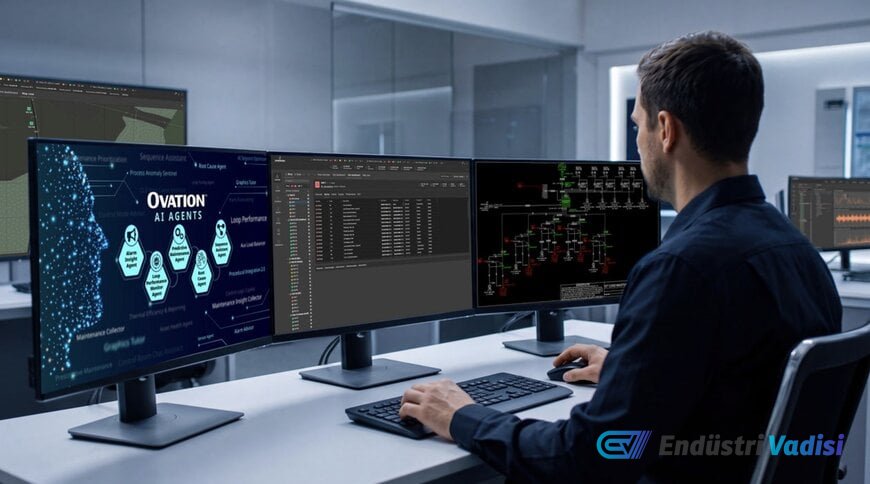
Emerson has integrated five new artificial intelligence agents into its Ovation Automation Platform to enhance fault detection and operational resilience in power and water facilities. The Ovation AI agents provide continuous monitoring, pattern recognition, and contextual recommendations to solve complex diagnostic challenges.
Human-Centric Architecture and Integration
These new AI agents operate directly in sync with the platform's native operational tools, unlike external analytical layers or traditional chatbot interfaces. This eliminates the need for operators to switch between systems. The system implements a strict "human-in-the-loop" mechanism, where all AI-driven optimizations and operational adjustments are presented as contextual recommendations requiring human approval. This design addresses industrial challenges such as workforce turnover, increasing automation complexity, and cognitive load during high-stress operational events.
Technical Capabilities of Specialized AI Agents
The initial software release includes five specialized agents targeting specific workflows within the industrial automation ecosystem:
- Sequence Assistant Agent: Provides diagnostic guidance for sequential function control logic. For example, it identifies stalled sequences and suggests corrective actions when starting a steam turbine.
- Alarm Analysis Agent: Contextualizes system data during alarm floods. It prioritizes and summarizes critical alerts, filtering out extraneous notifications to allow the operator to focus on important interventions.
- Predictive Maintenance Agent: Monitors critical plant equipment, acting as an early warning mechanism and generating maintenance recommendations based on continuous equipment health diagnostics.
- Root Cause Analysis Agent: Correlates system alarms, triggering events, and process variables in real-time. It traces the origin of equipment malfunctions across the plant architecture, enabling maintenance personnel to isolate systemic failures.
- Loop Performance Monitoring Agent: Continuously evaluates control loops to detect mechanical and algorithmic inefficiencies. It identifies dead bands, tuning errors, and oscillations, generating recalibration parameters.
Measurable Operational Impact and Application
Field applications of the Version 4.0 update show a reduction in process diagnostic times. In pre-tests, the Sequence Assistant Agent completed a diagnostic procedure that previously required extensive manual review in seconds. In another facility, predictive maintenance algorithms successfully detected early-stage equipment anomalies, preventing unplanned asset downtime.
Bob Yeager, President of Emerson Power and Water Solutions, stated that the AI-powered agents conduct simulations, predict failures, and prioritize interventions through their complex data analysis and pattern recognition capabilities. This allows operators to transition from reactive troubleshooting to proactive system management.
Scalability and Future Deployment Trajectory
Starting in Fall 2026, facilities will be able to selectively deploy individual agents based on specific operational requirements. The technology roadmap plans for the release of 28 additional agents across instrumentation, control, and cross-functional management. Emerson will also showcase the Ovation AI Agent Builder at the 2026 Ovation User Group Conference. This tool will allow facilities to design custom agents tailored to localized process variables and unique operational thresholds.
Additional Context: Competition and Technical Specifications
In the distributed control system (DCS) market for power and water generation, the Ovation platform competes with architectures such as Siemens SPPA-T3000, ABB Ability Symphony Plus, and Schneider Electric EcoStruxure. While traditional DCS platforms rely on deterministic logic and predefined alarm thresholds, the integration of autonomous, background-running AI agents represents an industrial shift towards probabilistic, continuous diagnostics. Emerson's approach of deploying native, workflow-specific agents directly within the DCS minimizes the integration latency associated with high-level enterprise AI platforms, bringing analytical power directly to the operator's native interface.