



Alper Aktaş
Endüstri Vadisi
- Thread Author
- #1
🤖 Revolutionizing Autonomous Systems: AMD's New Approach
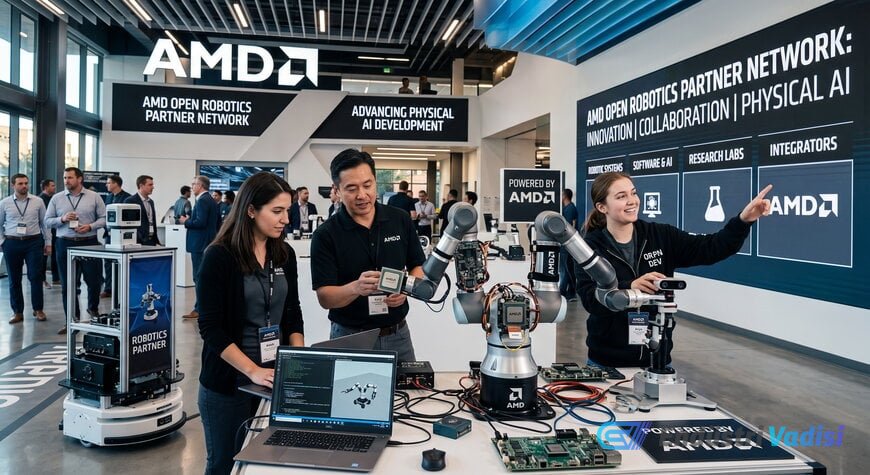
AMD has launched a groundbreaking ecosystem framework for autonomous industrial systems! This program aims to standardize software stacks and hardware integration in robotics and physical AI applications. The goal is to resolve compatibility issues between different vendors, creating standardized validation paths in physical AI, edge robotics, and digital twin environments.
⚙️ Integration Challenges and Solutions in Industrial Robotics
AI deployment in industrial robotics requires the synchronization of various subsystems. Developers often encounter latency and interoperability issues when combining proprietary software runtimes, specialized sensors, real-time control units, and simulation platforms.
To overcome these integration constraints, AMD is building a network of original design manufacturers, independent software vendors, sensor providers, and system integrators. This framework uses a shared hardware architecture and open standards to reduce integration complexity when transitioning from reference platforms to industrial production.
🧠 Technical Architecture and Standardized Toolchains
The technical foundation extends from embedded edge processors to data center infrastructure:
- Edge Processing: AMD Ryzen AI Embedded processors, Kria System-on-Modules, and Versal adaptive SoCs.
- Central Processing: AMD EPYC server processors and AMD Instinct graphics processing units are used for training, high-fidelity simulation, and fleet analytics.
This infrastructure is supported by a standardized open software stack that connects hardware and middleware providers, digital twin partners, and system integrators.
Software execution occurs through open frameworks, preventing reliance on proprietary runtimes. Heterogeneous acceleration for AI workflows is provided by the AMD ROCm open compute driver ecosystem. Real-time sensor processing and spatial mapping are done with accelerated ROS 2 perception nodes, while framework-agnostic AI model execution is maintained through ONNX, Vitis AI, and Ryzen AI runtimes. Hardware validation and edge prototyping are performed using the Kria AI Robotics platform.
This architecture allows developers to deploy custom neural networks and standard middleware pipelines across unified compute nodes.
🤝 Partnership and Validation Process
The partnership involves a four-tiered qualification structure focused on platform validation rather than licensing fees. Member organizations demonstrate technical compliance by publishing validated solutions using the AMD Robotics Software Stack.
Digital twin providers use the platform to train AI models and simulate physical kinematics before physical deployment. System integrators then apply these validated hardware and software configurations to factory automation, logistics, and medical technology environments, maintaining determinism and operational stability throughout the system lifecycle.