




Elif Özaksu
Corporate
- Thread Author
- #1
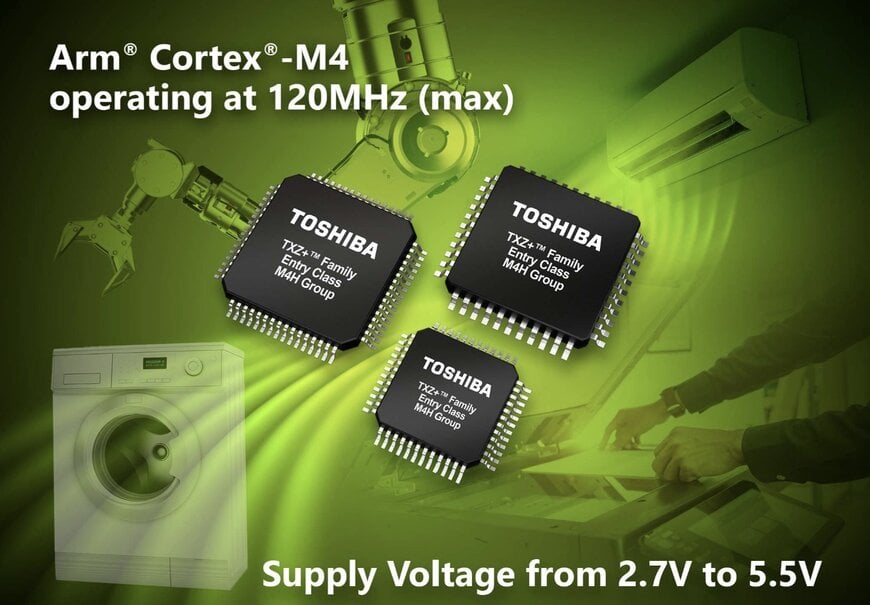
In the world of industrial automation and consumer electronics, microcontrollers are the heart of control systems. Toshiba is drawing attention with its new M4H group microcontrollers, designed to meet the needs in this field. These chips empower system control architectures thanks to their 32-bit Arm Cortex-M4 core.
─────────────────────────
⚙️ High-Performance Core and Memory Architecture
Designed to meet the real-time processing demands of embedded systems, these microcontrollers operate at clock frequencies up to 120 megahertz. Their internal architecture includes a hardware floating-point unit (FPU) and a memory protection unit (MPU). Additionally, equipped with 256 kilobytes of flash memory and 18 kilobytes of RAM, they can perform critical logic execution, interface processing, and time management tasks without the need for secondary auxiliary processors.
─────────────────────────
🔌 Peripheral Integration and Voltage Tolerances
These devices support a wide operating supply voltage range of 2.7 to 5.5 volts, offering direct compatibility with standard 5-volt industrial power rails. The integration of a 10-megahertz high-speed oscillator with ±1 percent accuracy eliminates the need for external timing components, saving printed circuit board (PCB) space.
The system-on-chip (SoC) includes a 12-bit analog-to-digital converter (ADC), direct memory access (DMA), and standard communication interfaces such as UART, SPI, I2C. Furthermore, the integrated advanced programmable motor driver (A-PMD) provides direct control loops for brushless direct current motors (BLDC), commonly used in heavy-duty devices and factory systems.
─────────────────────────
📦 Hardware Packaging and Development Ecosystem
To accommodate various footprint constraints, the devices are offered in low-profile quad flat packages (LQFP): 64-pin and 48-pin (0.5 millimeter pitch) and 44-pin (0.8 millimeter pitch) configurations. To accelerate the transition from evaluation to mass production, firmware development processes utilize Common Microcontroller Software Interface Standard (CMSIS) compliant drivers, ensuring interoperability with major integrated development environments (IDEs).
─────────────────────────
💡 Why Does the Toshiba M4H Group Make a Difference?
Among 32-bit microcontrollers targeting industrial and appliance motor control, competitors include the STMicroelectronics STM32G4 series and the NXP Semiconductors KE1xF family. However, the most significant differentiator of the Toshiba M4H group is its direct 5.5-volt input support. While many modern Arm Cortex-M4 integrated circuits are limited to a maximum 3.6-volt supply, Toshiba's approach enhances electromagnetic compatibility and noise immunity in electrically challenging environments like factory settings, eliminating the need for external step-down voltage regulators.
The 120-megahertz clock speed provides high computational throughput, while the 18 kilobytes of RAM versus 256 kilobytes of flash memory ratio is optimized for in-place execution control algorithms rather than data-intensive buffering tasks. Compared to the NXP KE1xF, the M4H also offers a similar integrated programmable motor driver, allowing both platforms to autonomously perform sensorless vector control for brushless motors.
─────────────────────────
Toshiba's new M4H group microcontrollers offer a powerful solution for engineers seeking high performance, durability, and integration in the industrial automation and consumer electronics sectors. Especially their 5-volt tolerance and advanced motor control capabilities enable these chips to stand out in demanding applications.