








Alper Aktaş
Endüstri Vadisi
- Thread Author
- #1
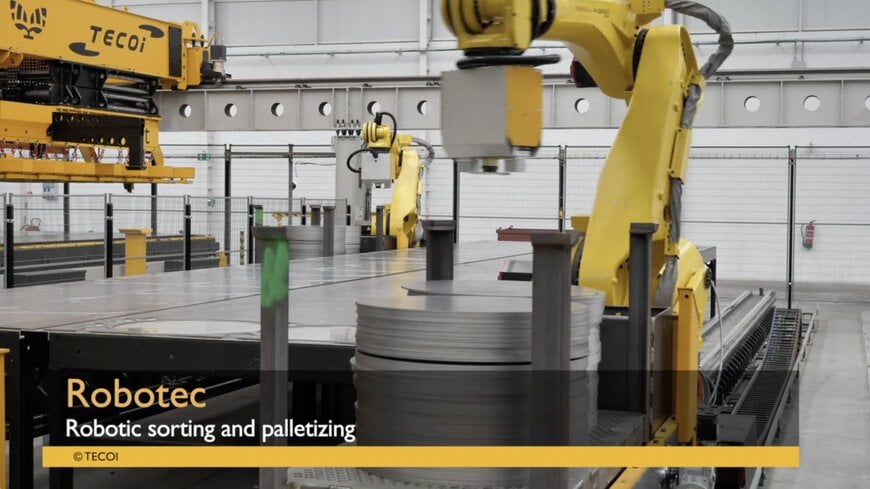
The pursuit of efficiency and automation in the sheet metal processing industry continues unabated. Taking a significant step in this field, Lantek and TECOI have developed an innovative solution that combines modular cutting architectures with adaptive robotic systems, offering continuous unloading and sorting capabilities in industrial automation workflows.
─────────────────────────
🤝 The Foundation of Collaboration and Challenges ⚙️
Lantek is known for its software solutions for the sheet metal sector, while TECOI manufactures heavy-duty sheet metal cutting machines. The primary goal of this strategic partnership is to eliminate production downtimes caused by manual or sequential part sorting and unloading processes. To create a continuous flow production system, TECOI's hardware engineering was combined with Lantek's geometric algorithms. This made it possible to synchronize large-scale cutting and handling processes.
─────────────────────────
🚀 Application Areas and Operational Benefits 📈
This integrated system targets high-volume sheet metal fabrication and associated industrial logistics processes. Technical use cases include continuous cutting, extraction, and separation of multi-part steel sheets. The system ensures process stability by eliminating the need to stop cutting operations for part removal, increases machine utilization rates, and maintains full traceability of each component from the cutting table to the final pallet.
─────────────────────────
🔬 Technical Solution and Responsibilities 💡
The integrated system utilizes TECOI's CF modular cutting architecture, designed for multi-head cutting processes. TECOI is responsible for the physical handling hardware, which includes a servo-automatic crane equipped with lifting magnets to transfer the cut material to an intermediate stacking area. Here, robotic units using adaptive gripping technology pick up the parts. Lantek, on the other hand, provides the control logic through computer-aided design and manufacturing instructions. The software arranges parts according to specific geometry and angular orientation, instructing the robots to stack identical parts together, thereby optimizing pallet stability.
─────────────────────────
🛠️ Deployment and Implementation Process 🏭
Distributed as part of the broader Sortec framework, this system is designed to automate production lines from initial processing to final palletizing. The architecture uses a collaborative robot-based framework that integrates with existing floor layouts. The modular design allows engineers to deploy additional robotic units synchronously, increasing unloading capacity for high-throughput facilities and providing scalability without the need for full system overhauls.
─────────────────────────
🎯 Outcomes and Expected Impact 📊
The primary measurable mechanism of this integration is the parallel execution of cutting and palletizing operations. The cutting heads remain continuously operational as part handling is transferred to an intermediate zone managed by synchronized robots. This parallel processing architecture reduces machine idle time and increases overall production throughput, adapting to both low-demand facilities and large-scale manufacturing operations without compromising precision.



















