





Alper Aktaş
Endüstri Vadisi
- Thread Author
- #1
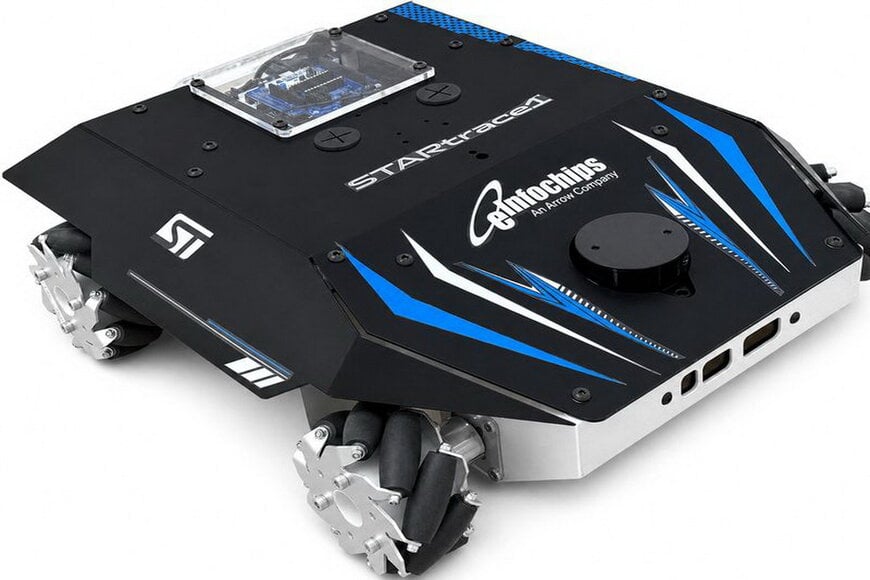
The future of industrial automation is being shaped by the proliferation of autonomous mobile robots (AMRs). However, developing these robots presents significant challenges in combining real-time motion control with artificial intelligence processing capabilities. This is precisely where two industry giants, Arrow Electronics and STMicroelectronics, have joined forces with their engineering services subsidiary eInfochips to take a revolutionary step: they have developed a joint reference platform for AMRs!
─────────────────────────
💡 Smart Solution to Integration Challenges
This collaboration focuses on the integration problems faced by original equipment manufacturers (OEMs). The developed platform simplifies the development of autonomous mobile robots for logistics centers, manufacturing facilities, and automated laboratories by combining a specialized real-time control architecture with advanced computing modules. The system coordinates sensor fusion, localization, and power regulation under one roof, minimizing engineering risks associated with custom subsystem validation processes.
─────────────────────────
⚙️ Technical Architecture and Sensor Fusion
At the heart of the platform is an NVIDIA Jetson Orin Nano processing module that manages high-level processing tasks (including simultaneous localization and mapping). This module runs on an industrial Robot Operating System 2 (ROS 2) stack. Real-time motor motion and low-level sensor data collection are provided by a dedicated STM32 microcontroller board.
[]Motion Control: Dual brushless direct current (BLDC) motor drivers are implemented using STSPIN32 and STDRIVE controllers. These controllers regulate wheel speeds based on feedback from integrated micro-electromechanical systems (MEMS) inertial measurement units (IMUs), magnetometers, and environmental sensors.
[]Navigation: The primary navigation line receives data from external lidar and vision sensors. These inputs are processed through Nav2 and Cartographer algorithms, enabling dynamic obstacle avoidance and precise indoor localization.
- Power Management: The electrical subsystem features power and battery management circuits optimized for 24-volt operations. There is also an architectural path designed to accommodate 48-volt industrial power grids. This power distribution system provides consistent current to the drive motors while maintaining isolated voltage rails for digital computing components.
─────────────────────────
📊 Why is This Platform Important?
This reference platform addresses a market segment where development time and interoperability between components are critical. In traditional approaches, developers using industrial single-board computers had to independently design power distribution boards, write custom motor driver abstraction layers, and validate sensor timing synchronization. However, this reference design greatly simplifies things by pre-integrating all these elements.
The use of specialized silicon, particularly STSPIN32, offers significant advantages by reducing physical board space and propagation delay compared to discrete microcontroller and gate driver assemblies connected via standard serial data buses.
─────────────────────────
🎯 Conclusion
This collaboration between Arrow and STMicroelectronics is an important step that will accelerate the integration of autonomous mobile robots into industrial applications and simplify development processes. This reference platform lays a solid foundation for the smart factories and logistics centers of the future.